





Angkor Wat, Cambodia
the timeless wonder of southeast asia
6/11/2026
Rising from the lush jungles of northwestern Cambodia, Angkor Wat stands as one of the most extraordinary monuments ever created by human hands. Its soaring towers, intricate stone carvings, and vast ceremonial grounds have captivated travelers, historians, archaeologists, and spiritual seekers for centuries. More than simply a temple, Angkor Wat is a symbol of Cambodia itself—a masterpiece of architecture, a testament to a powerful empire, and one of the world's greatest cultural treasures.
Today, millions of visitors journey to Cambodia each year to witness the grandeur of Angkor Wat. Yet beyond its iconic silhouette lies a remarkable story spanning nearly a thousand years, encompassing kings and warriors, religion and empire, decline and rediscovery.
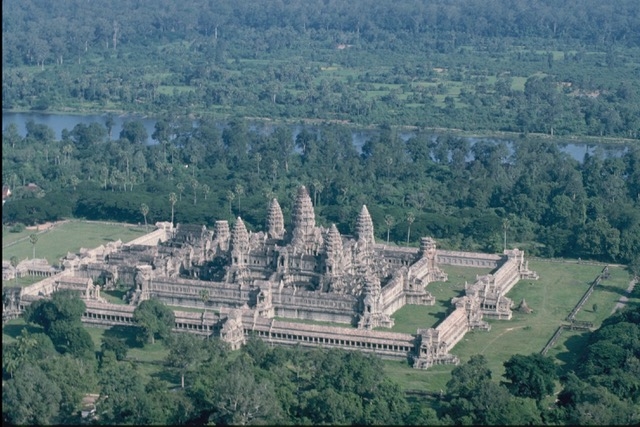
Angkor Wat is located near the modern city of Siem Reap in northwestern Cambodia, approximately 200 miles northwest of Phnom Penh, the nation's capital. The temple forms part of the larger Angkor Archaeological Park, a UNESCO World Heritage Site covering more than 150 square miles.
The park contains the remains of the ancient Khmer Empire's capital cities and includes dozens of major temples and hundreds of smaller structures scattered throughout forests, reservoirs, and villages. While Angkor Wat is the crown jewel, visitors are often amazed to discover an entire ancient civilization hidden within the surrounding landscape.
The tropical climate of Cambodia contributes to the region's lush beauty. Towering palm trees, dense jungle vegetation, and reflective moats create a setting that feels almost magical, particularly during sunrise and sunset when the temples glow with golden light.
To understand Angkor Wat, one must first understand the Khmer Empire.
Between the 9th and 15th centuries, the Khmer Empire became one of the most powerful civilizations in Southeast Asia. At its height, it controlled territories that extended into present-day Thailand, Laos, Vietnam, and Myanmar.
The empire's rulers developed sophisticated systems of governance, engineering, agriculture, and architecture. Massive reservoirs and canals allowed the Khmer people to manage seasonal water supplies and support a population estimated at over one million people—making Angkor one of the largest urban centers in the world at the time.
This prosperity enabled Khmer kings to construct monumental temples that reflected both political power and religious devotion.
Angkor Wat was commissioned during the reign of King Suryavarman II in the early 12th century, around 1113–1150 AD.
Unlike many earlier Khmer temples dedicated primarily to Hindu deities such as Shiva, Angkor Wat was built as a grand temple dedicated to Vishnu, one of Hinduism's principal gods. Scholars believe the temple also served as the king's state temple and possibly his mausoleum.
Construction required immense resources and labor. Thousands of workers, craftsmen, architects, and artisans participated in the project. Massive sandstone blocks were quarried from the Kulen Mountains, located more than 30 miles away, and transported via canals and waterways.
The result was an architectural achievement unlike anything the world had seen.
Angkor Wat is the largest religious monument ever constructed.
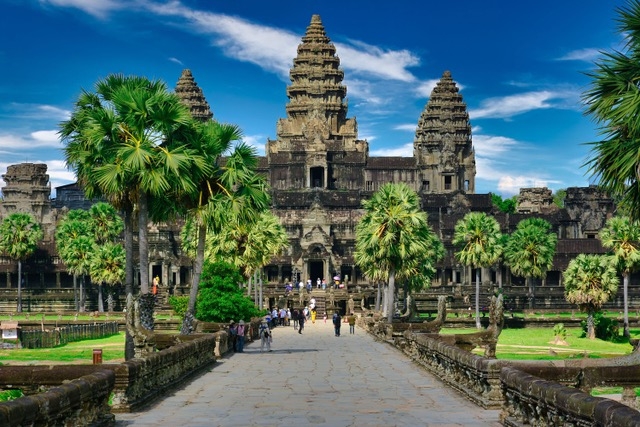
The temple complex covers approximately 500 acres and is surrounded by a vast moat measuring nearly 650 feet wide. Visitors enter via a long sandstone causeway that leads toward the temple's central towers.
The design symbolizes Mount Meru, the mythical mountain believed in Hindu cosmology to be the center of the universe and home of the gods.
Five distinctive towers form the temple's central sanctuary. The highest tower rises approximately 213 feet above the ground and dominates the skyline.
What makes Angkor Wat particularly remarkable is its mathematical precision and symbolic design. Every dimension, courtyard, gallery, and tower reflects sophisticated religious concepts and astronomical alignments.
The temple is oriented toward the west—an unusual choice among Khmer temples—and one that continues to intrigue scholars today.
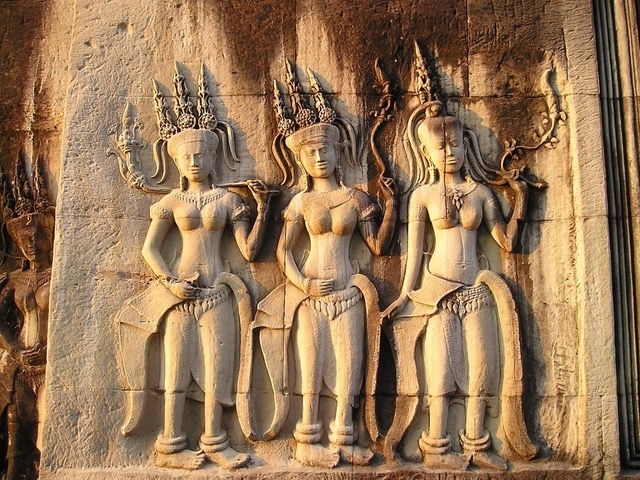
Perhaps the most astonishing feature of Angkor Wat is its extensive collection of bas-relief carvings.
Stretching for nearly half a mile, these carvings tell epic stories from Hindu mythology and Khmer history. They depict gods and demons, celestial dancers, warriors, kings, battles, and scenes of daily life.
Among the most celebrated carvings is "The Churning of the Ocean of Milk," a vast scene portraying gods and demons working together to create the elixir of immortality.
Thousands of graceful apsaras—heavenly dancers—adorn the temple walls. Each figure possesses unique facial expressions, jewelry, hairstyles, and clothing details, demonstrating the extraordinary skill of Khmer artisans.
Visitors often spend hours examining these intricate carvings, discovering new details with every glance.
Over time, Cambodia's dominant religion shifted from Hinduism to Buddhism.
By the late 12th and early 13th centuries, Buddhist traditions increasingly influenced Khmer society. Unlike many ancient religious structures abandoned during such transitions, Angkor Wat adapted and remained an active place of worship.
Buddhist statues were added throughout the complex, and the temple gradually transformed into a Buddhist sanctuary.
This continuous religious use helped preserve Angkor Wat long after many neighboring temples fell into neglect.
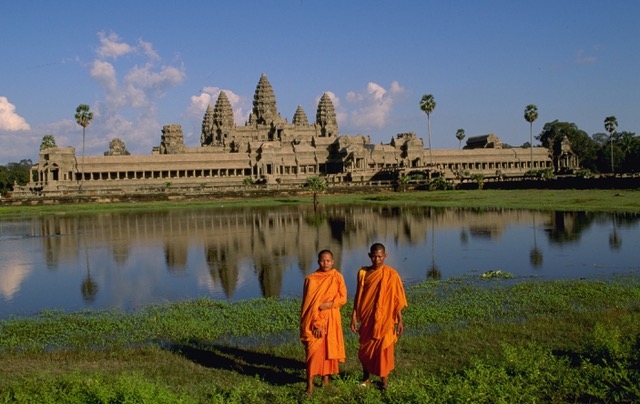
Even today, saffron-robed Buddhist monks can be seen praying within its sacred halls, creating a living connection between past and present.
By the 15th century, the Khmer Empire faced mounting challenges.
Political instability, shifting trade routes, invasions from neighboring kingdoms, and environmental pressures weakened the empire's dominance. Around 1431, forces from the Kingdom of Ayutthaya, in present-day Thailand, captured Angkor.
Gradually, the royal court relocated southward toward the region surrounding modern Phnom Penh.
While Angkor Wat continued functioning as a religious center, much of the surrounding urban landscape was abandoned and reclaimed by nature. Dense jungle vegetation slowly enveloped many temples and monuments. For centuries, Angkor became a place of legend.

Although Angkor was never truly lost to local Cambodian communities and Buddhist monks, it became largely unknown in Europe.
The temple gained international attention in the 19th century when French naturalist Henri Mouhot documented his travels in Cambodia. His vivid descriptions introduced Angkor Wat to Western audiences and sparked widespread fascination.
Explorers, archaeologists, artists, and scholars soon followed.
The French colonial administration later initiated extensive restoration efforts, clearing vegetation and stabilizing damaged structures. These early conservation projects laid the groundwork for the preservation work that continues today.
In 1992, Angkor was designated a UNESCO World Heritage Site.
This recognition brought increased international support for preservation and research. Conservation teams from numerous countries have collaborated to protect the temples from environmental damage, weathering, tourism pressures, and the effects of Cambodia's turbulent modern history. Today, Angkor is considered one of humanity's most important archaeological treasures. Its preservation remains a global priority.
For many travelers, the highlight of a visit is witnessing sunrise over Angkor Wat. Before dawn, visitors gather beside reflective pools facing the temple. As the first rays of sunlight illuminate the sky, the iconic towers emerge as dramatic silhouettes against shades of orange, pink, and gold
The experience is unforgettable.
Exploring the temple itself reveals a labyrinth of galleries, courtyards, staircases, and sanctuaries. Every corridor presents new carvings, architectural details, and viewpoints.
Many visitors spend several days exploring the broader Angkor Archaeological Park, which contains numerous extraordinary sites.
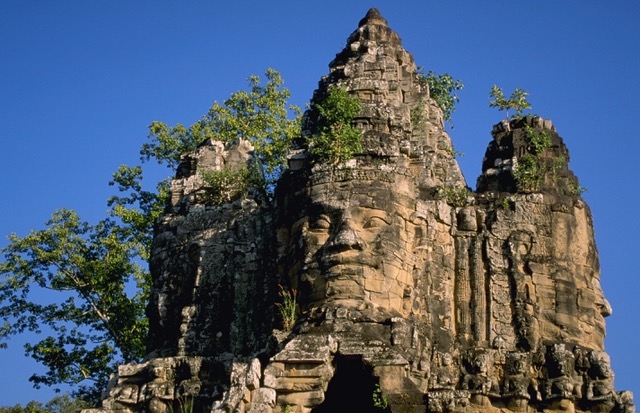
Located at the center of Angkor Thom, Bayon is famous for its giant stone faces. More than 200 serene faces gaze outward from towering structures, creating one of Southeast Asia's most memorable archaeological landscapes.
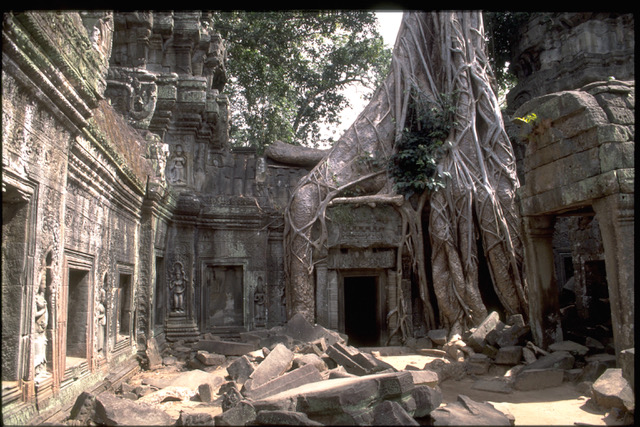
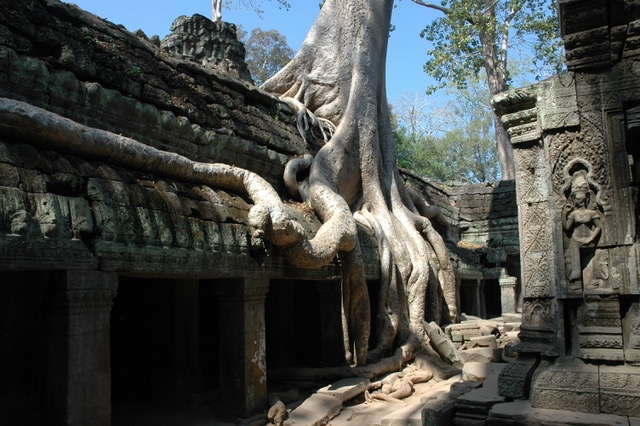
Often called the "Tomb Raider Temple" due to its appearance in the film starring Angelina Jolie, Ta Prohm is renowned for massive tree roots intertwining with ancient stone walls. The dramatic fusion of architecture and nature creates an atmosphere unlike any other site in the world.
Known as the "Citadel of Women," this smaller temple is celebrated for its remarkably detailed pink sandstone carvings, often regarded as the finest examples of Khmer artistic achievement.
A sprawling temple complex featuring long corridors, hidden chambers, and towering trees, Preah Khan offers visitors a more intimate glimpse into Angkor's mystical atmosphere.
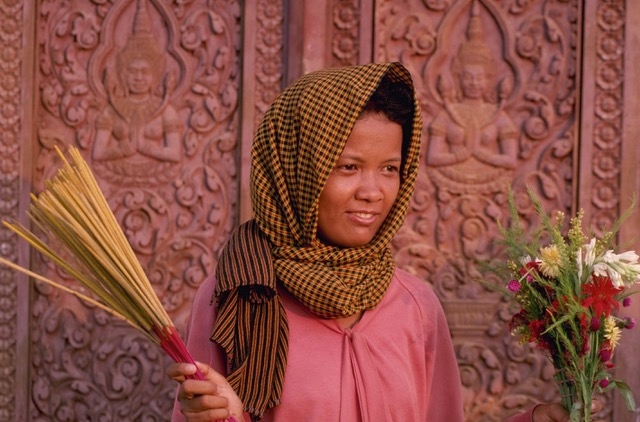
A visit to Angkor Wat is also an opportunity to experience Cambodian culture. The nearby city of Siem Reap has evolved into one of Southeast Asia's most welcoming tourism destinations. Visitors can enjoy traditional Khmer cuisine, colorful markets, cultural performances, and luxury accommodations ranging from boutique hotels to world-class resorts. Traditional Cambodian dishes such as fish amok, beef lok lak, and fragrant curries provide memorable culinary experiences. Local artisans continue ancient traditions of silk weaving, wood carving, silverwork, and stone sculpture, helping preserve Cambodia's rich cultural heritage.

The most popular time to visit Angkor Wat is during Cambodia's dry season, typically from November through March.These months offer cooler temperatures and lower humidity, making exploration more comfortable.
The rainy season, from May through October, has its own advantages. Fewer tourists, lush greenery, and dramatic skies create exceptional photographic opportunities. Regardless of the season, early morning and late afternoon provide the most pleasant conditions and the most beautiful light for sightseeing.
Angkor Wat occupies a unique place in Cambodian identity. It appears prominently on Cambodia's national flag, making Cambodia the only country in the world whose flag features a specific building. For Cambodians, Angkor Wat represents resilience, creativity, spirituality, and national pride. It stands as a reminder of a civilization that achieved extraordinary accomplishments and left an enduring legacy for future generations.
Few destinations inspire the imagination like Angkor Wat. Its towering spires, magnificent carvings, and sacred atmosphere transport visitors across centuries into a world of kings, gods, and monumental ambition. It is a place where history comes alive, where architecture becomes art, and where ancient spirituality still echoes through stone corridors. Whether viewed at sunrise, explored beneath the shade of jungle trees, or admired through the lens of history, Angkor Wat remains one of the greatest wonders ever created.
For travelers seeking beauty, culture, and a deeper connection to humanity's past, there are few experiences more rewarding than standing before the timeless majesty of Angkor Wat—Cambodia's greatest treasure and one of the world's most extraordinary destinations.
Since 1989, First Cabin Travel has offered luxury-styled itineraries to unique and varied destinations worldwide with the mainstay of bookings derived from repeat clientele and their enthusiastic referrals. First Cabin has come to be known as your Passport to Excellence. CA Reg: 2016168-40