






Balboa Park
Balboa Park - A living masterpiece of history, culture, and gardens
12/27/2025
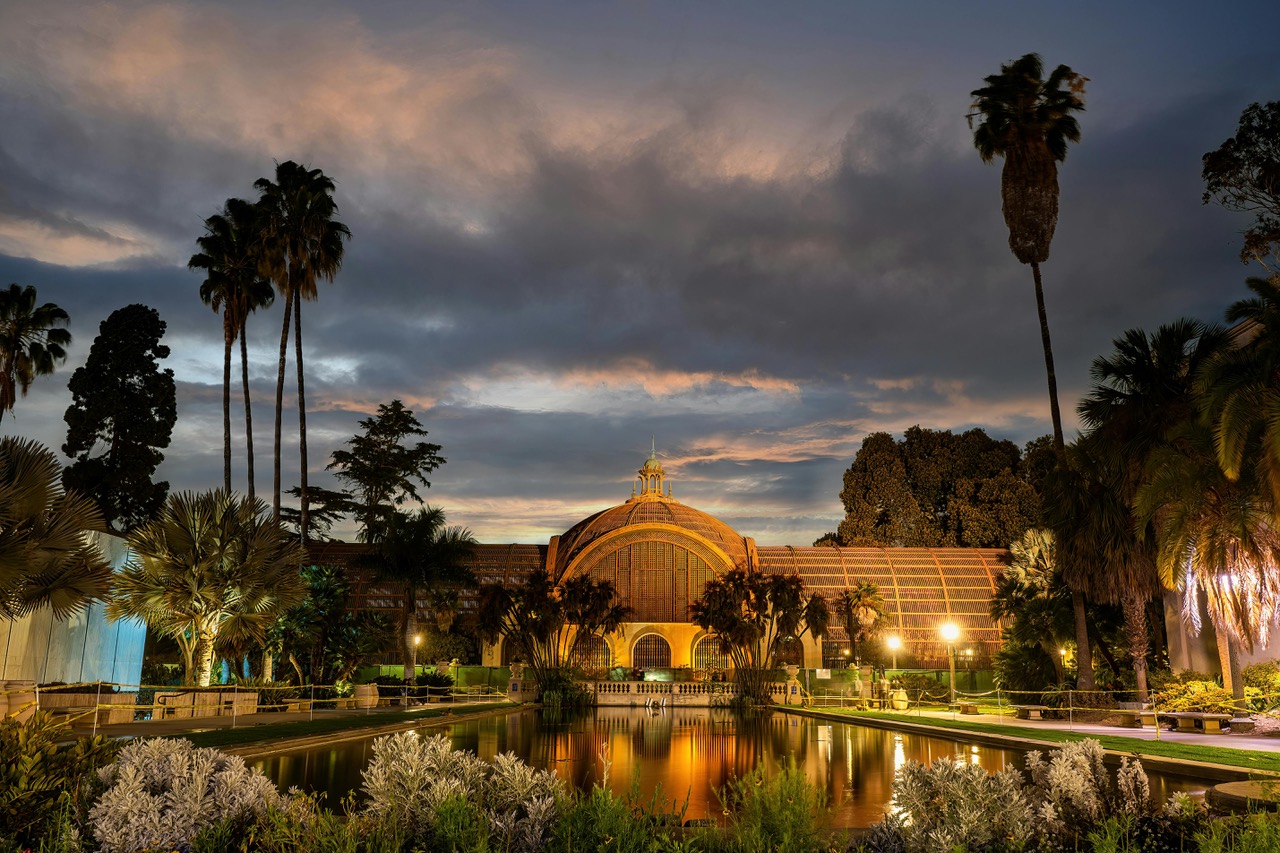
Balboa Park is not merely San Diego’s central park—it is the city’s grand civic stage: a 1,200-acre tapestry of architecture, museums, performance halls, gardens, and promenades that has continually reinvented itself while holding fast to its original promise—beauty with purpose. Long before visitors drifted beneath the colonnades of El Prado or paused by the lily pond to watch the light change, this land was set aside as a public asset, then elevated—almost mythically—by two world’s fairs that gave San Diego a lasting cultural identity.
Today, the park is both historic and immediate: a place where Spanish-Colonial Revival silhouettes meet contemporary exhibitions, where a morning walk through Palm Canyon can lead to an afternoon inside a space capsule, and where the evening may end under stage lights at The Old Globe. To understand Balboa Park is to understand San Diego’s ambition—its desire to be more than a coastal town, and instead, a world city with a permanent heartbeat of art, science, performance, and gardens.
Balboa Park’s story begins with a civic decision that feels unusually generous by modern standards: to preserve a vast tract of land for public use in a growing city. What was once largely open space would become the canvas for an audacious experiment—one that fused philanthropy, architecture, horticulture, and cultural life into a single destination. Even the park’s name carries a spirit of exploration. City leaders ultimately chose “Balboa Park” to honor Vasco Núñez de Balboa, the Spanish-born explorer remembered as the first European to see the Pacific Ocean from the Americas. But the true turning point—the moment the park’s destiny crystallized—arrived with a world’s fair.
In 1915, as the Panama Canal captured global imagination, San Diego staged the Panama–California Exposition in Balboa Park, a monumental event designed to position the city as the first major U.S. port of call for ships traveling north after passing through the canal. The exposition did more than entertain. It built a city’s cultural blueprint.
The fair introduced a visual language that still defines Balboa Park: romantic plazas, ornate towers, arcades, and richly detailed façades—an architectural confidence that turned what had been open land into a coherent “city within a city.”
This was a critical choice: while world’s fair structures were often temporary, leaders and citizens pushed to preserve key buildings and repurpose them for civic and cultural use—a decision that allowed Balboa Park to evolve into a permanent museum and arts campus.
Among the most beloved survivors of the exposition is the Botanical Building—created for the 1915–16 fair and paired with the lily pond/lagoon, becoming one of the park’s most photographed and quietly iconic scenes.
Two decades later, during the Great Depression, Balboa Park became the stage for another fair: the California Pacific International Exposition (1935–1936). While the first exposition put San Diego “on the map,” the second reaffirmed the park as a civic centerpiece worth sustaining—and modernized parts of the grounds and gardens to meet a new era of visitors. This is also the moment when one of the park’s most celebrated institutions was born.
The Old Globe Theatre was built in 1935 as part of the California Pacific International Exposition, modeled after Shakespeare’s Globe in London, and originally intended for abridged productions of Shakespeare’s plays for fairgoers. When the exposition ended, the story could have ended with it. Instead, a nonprofit organization leased and renovated the theatre for ongoing use—an arrangement that continues in essence today—transforming what began as fair entertainment into one of America’s leading regional theatre companies. A night at The Old Globe feels inseparable from the park itself: you arrive through gardens and courtyards, and the experience has the layered elegance of Balboa Park—history, artistry, and civic pride in one place.
Balboa Park’s cultural core is its museum constellation—an unusually dense and walkable assembly that spans art, anthropology, aviation, science, and more. The park’s museum ecosystem is so extensive it is often navigated through curated museum lists and passes, reflecting how central these institutions are to the Balboa Park experience. Below are highlights that speak directly to the park’s most celebrated categories—especially those you requested.
Set within Balboa Park’s museum district, the San Diego Automotive Museum is where industrial design becomes personal history. It appeals to a wide range of visitors—collectors, casual enthusiasts, families—because automobiles tell stories beyond horsepower: they reflect eras, ideals, and the evolving relationship between technology and lifestyle. In Balboa Park, it fits perfectly: a museum that is as much about culture and craft as it is about mechanics. The best visits here are unhurried—time enough to notice the curve of a fender, the restraint (or exuberance) of a dashboard, the way a single vehicle can evoke a decade.
A short walk from gardens and courtyards, the Air & Space Museum makes Balboa Park feel almost cinematic—one moment you’re among palms and tilework, the next you’re immersed in the dream of flight. The museum emphasizes visitor access and public-facing programming, maintaining a robust schedule and admissions operations typical of a major regional institution. And in the context of Balboa Park’s origin story, the connection is poetic: the park rose to fame through a fair celebrating global travel and maritime possibility; the Air & Space Museum continues that narrative—humanity’s restless desire to go farther.
Science has a home in Balboa Park that feels modern, interactive, and family-friendly while still aligning with the park’s mission: learning as a civic pleasure. The Fleet describes itself as San Diego’s science center, built around experiences that bring the community together through curiosity and discovery. For visitors, it balances well with the day’s more formal museum experiences—an energizing stop between galleries, gardens, and performances.
If Balboa Park is San Diego’s cultural heartbeat, its gardens are the park’s breathing—steady, restorative, and endlessly revisited. Even longtime locals return for the same reason: the gardens change hour by hour, season by season, and somehow always feel newly composed.
As noted, the Botanical Building and adjacent lily pond/lagoon were built for the 1915–16 exposition and remain a must-see centerpiece, featuring thousands of plants and vibrant seasonal displays. Alcazar Garden: A Formal Jewel Box Alcazar Garden is one of the park’s most “designed” moments—structured, symmetrical, and lush, with plantings engineered for visual impact. It was patterned after the gardens of the Alcázar in Seville and reconstructed to replicate the 1935 design. It’s the sort of garden that invites a slower pace—less a pass-through, more a pause.
Balboa Park’s Japanese Friendship Garden and Museum is not only a beautiful landscape, but also a cultural statement—created to represent the bond between San Diego and its sister city, Yokohama. The garden features koi ponds, water features, traditional structures, and educational programs that deepen the experience beyond the visual. And this is the point: Balboa Park’s gardens are not decoration—they are expressions of heritage, design, and intentional calm.
Balboa Park’s genius is that it never insists on a single theme. It is a collection of worlds—each one complete enough to justify a visit on its own, yet close enough to invite a spontaneous day of discovery.
A few experiences that consistently define the park for visitors:
-
El Prado’s promenades and plazas, where architecture is part of the attraction—an open-air gallery of San Diego’s most iconic civic design language.
-
International Cottages and cultural houses, which turn an afternoon stroll into a passport of performances, crafts, and community celebrations.
-
Rotating cultural institutions and contemporary exhibits, reflecting how the park continues to expand its scope rather than simply preserve its past.
And then there are the “signature” experiences that shape memory: the feeling of walking from a formal garden into a museum, then into a theatre—never needing a car, never leaving the park’s atmosphere.
Many great parks are beautiful. Fewer are cultural engines. Balboa Park endures because it was built at the intersection of civic ambition and public pleasure—then fortified by two expositions that left architecture, institutions, and a worldview behind. It is, in a sense,
San Diego’s most elegant promise: that the arts and sciences belong not behind gates, but in the center of the city; that gardens deserve as much reverence as galleries; and that history should be something you can walk through on a sunny afternoon.
Balboa Park doesn’t ask visitors to choose between relaxation and enrichment. It offers both—seamlessly—and that is why it remains one of America’s most distinctive urban parks: a living landmark where San Diego continuously meets itself, and invites the world to do the same.