






Bhutan
where happiness became a national treasure
8/14/2026
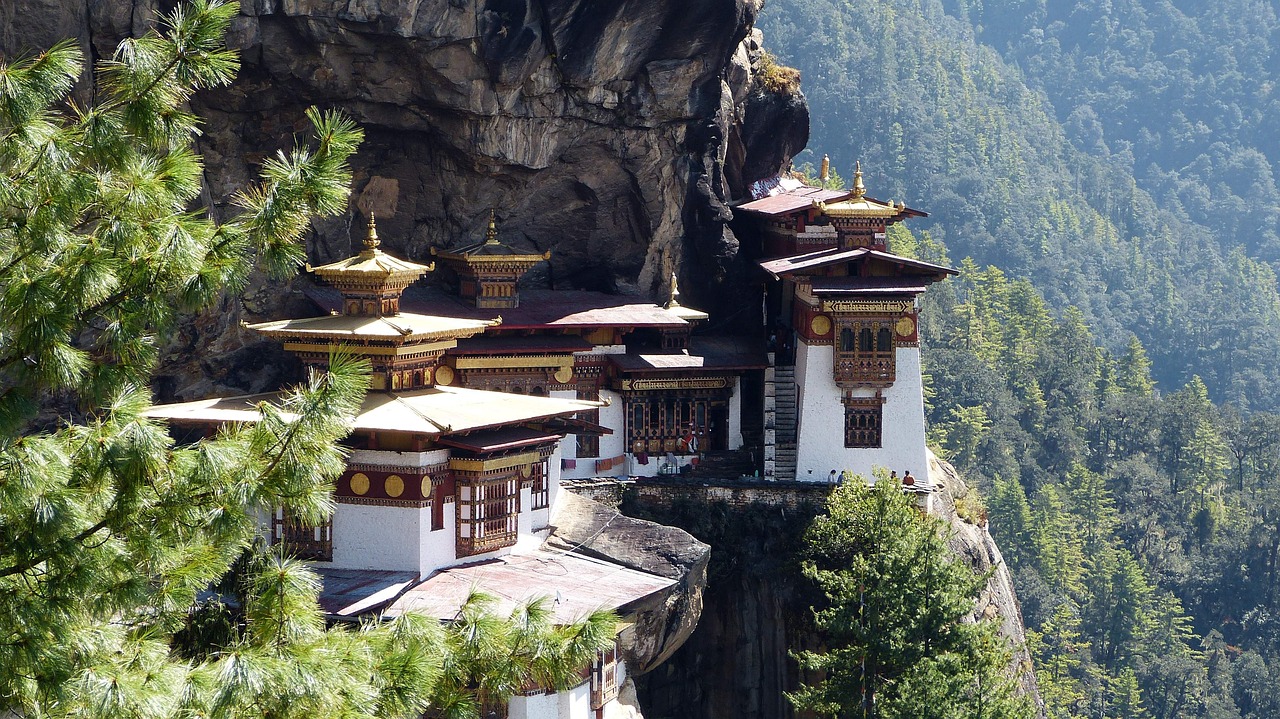
High in the eastern Himalayas, tucked between the immense territories of India and China, lies a kingdom that spent much of its history seemingly content to remain beyond the reach of the modern world. Bhutan is a place of forested mountains and isolated valleys, ancient fortresses, fluttering prayer flags and monasteries that appear to have grown directly from cliffsides. Known to its people as Drukyul, the Land of the Thunder Dragon, it is one of those increasingly rare destinations where arriving can feel less like entering another country than crossing into another age.
For centuries, geography helped protect Bhutan from the forces reshaping much of Asia. Great mountains formed natural barriers. Roads were few. Communities developed in valleys separated by steep ridges, forests and rivers. Tradition, religion and monarchy became powerful threads binding these communities together. Even today, Bhutan's identity is defined as much by what it has chosen not to pursue as by what it has embraced.
The country did not rush toward mass tourism. It did not throw open its valleys to unlimited development. It did not measure national progress exclusively through economic growth. Instead, Bhutan became internationally famous for an idea that sounded almost radical when it began attracting attention decades ago: that the happiness and well-being of a nation's people should matter at least as much as the amount of money its economy produces.
This is the Bhutan that captivates visitors today: deeply Buddhist yet increasingly sophisticated, ancient yet carefully modernizing, remote yet home to some of the world's most luxurious hotels.
And towering above its many extraordinary sights is one image that has come to symbolize the entire kingdom — a monastery seemingly suspended in the clouds.
Tiger's Nest
A Kingdom Shaped by the MountainsHuman settlement in the territory that became Bhutan reaches back thousands of years, although much of the country's earliest history survives through religious traditions, legends and oral accounts rather than conventional historical records.
Bhutan's recorded history becomes clearer with the arrival and expansion of Buddhism. According to Bhutanese tradition, the great Buddhist master Padmasambhava, better known throughout Bhutan as Guru Rinpoche, arrived during the eighth century. His influence upon Bhutan would become so profound that he is revered as the "Precious Master" and often regarded as a second Buddha.
Buddhism gradually became inseparable from Bhutanese identity.
Over succeeding centuries, religious teachers established monasteries and temples throughout the valleys. Different Buddhist schools developed followers, and religious institutions became centers not merely of worship but of education, art, administration and community life.
The political foundations of modern Bhutan took shape much later.
During the 17th century, Zhabdrung Ngawang Namgyal, a Buddhist lama and statesman who came from Tibet, succeeded in bringing much of the country together under a unified system. His influence remains visible everywhere in Bhutan, particularly through the extraordinary dzongs — immense fortress-monasteries strategically constructed throughout the kingdom.
These structures served both spiritual and practical purposes. Part monastery, part fortress and part administrative headquarters, they became symbols of a nation in which religious and secular authority were intimately connected.
Bhutan eventually endured periods of internal rivalry and regional conflict, but in 1907 Ugyen Wangchuck was chosen as the country's first hereditary king, establishing the Wangchuck dynasty that continues today.
A century later Bhutan underwent another remarkable transition. Rather than having democracy forced upon the monarchy, the country's kings themselves encouraged political modernization. In 2008 Bhutan became a democratic constitutional monarchy and held its first parliamentary elections.
Yet through these changes, Bhutan has maintained an unusual degree of cultural continuity.
To understand Bhutan, one must understand that Buddhism here is not confined within monasteries.
It spills into the landscape.
Prayer flags stretch across bridges, forests and mountain passes. Small chortens, or stupas, appear beside roads and pathways. Prayer wheels turn beneath the hands of elderly pilgrims. Monks in maroon robes walk through town streets. Families maintain shrines within their homes.
Before Buddhism, forms of Bon and nature worship were practiced throughout the region, and traces of those beliefs remain interwoven with Bhutanese spiritual traditions. Mountains, rivers, forests and particular locations can possess sacred significance. The natural and spiritual worlds are not necessarily regarded as separate realms.
The dominant religious tradition is Vajrayana Buddhism, with the Drukpa Kagyu school playing an especially important role in Bhutan's history and institutions. The older Nyingma tradition, associated closely with Guru Rinpoche, is also deeply rooted throughout the country.
Compassion, karma, reincarnation and respect for sentient life influence daily thought and custom. Religious festivals remain important communal events, while astrologers and religious authorities may be consulted when choosing auspicious dates for marriages, construction projects or significant decisions.
It is difficult to separate Bhutanese art from religion as well. Temples contain elaborate paintings depicting Buddhist teachers, deities and spiritual narratives. Statues, mandalas, wood carvings and textiles preserve symbolism passed down through generations.
Even architecture reflects spiritual beliefs.
And nowhere is that relationship between faith, architecture and landscape more breathtaking than at Paro Taktsang.
There are famous buildings that become symbols of their countries: the Taj Mahal, the Eiffel Tower, the Colosseum. Bhutan has Tiger's Nest.
Its formal name is Paro Taktsang, and photographs almost fail to explain what makes it extraordinary. The monastery clings to the face of a sheer mountain approximately 900 meters — nearly 3,000 feet — above the floor of the Paro Valley.
White walls contrast sharply against dark stone. Golden roofs emerge from the mountainside. Clouds drift through the valley below.
From a distance, it seems impossible that human beings could have constructed anything there.
Yet the location was sacred long before the monastery existed.
According to Bhutanese Buddhist tradition, Guru Rinpoche came to the site in the eighth century and meditated within a cave on the mountain. The most famous version of the legend says that he arrived flying upon the back of a tigress.
It is from this story that Taktsang — commonly translated as Tiger's Nest or Tiger's Lair — takes its name.
The sacred caves became places of pilgrimage, meditation and religious devotion. Centuries later, the monastery complex took physical form around them.
Construction of the temple associated with the present complex was undertaken in the late 17th century, with the monastery completed in 1694 under Gyalse Tenzin Rabgye.
The achievement is astonishing even by modern standards.
Building materials had to be carried into extremely difficult terrain. Structures were positioned against steep rock faces where there was little room for error. Yet the architects created a complex that appears not to fight the mountain but to belong to it.
Tiger's Nest suffered a devastating fire in 1998, severely damaging the main structures. Bhutan undertook an extensive restoration, carefully reconstructing this national treasure while respecting its historic appearance and religious importance.
Today, reaching Tiger's Nest remains deliberately physical.
There is no road delivering visitors to the monastery door.
The journey is part of the experience.
The trail climbs through forests of pine. Prayer flags move in the Himalayan wind. As elevation increases, glimpses of the monastery begin appearing through the trees.
Then comes the view that travelers have crossed oceans to see.
Across a vast gorge, Tiger's Nest suddenly emerges against the cliff.
For many visitors, it is one of those increasingly uncommon travel experiences that becomes quiet rather than theatrical. People who have been talking throughout the climb often simply stop.
The final approach descends and climbs a series of steps near a waterfall before reaching the monastery itself. Inside, photography gives way to contemplation. The rooms are intimate compared with the immense landscape surrounding them. Butter lamps glow. Images of Buddhist masters and deities fill the shrines.
For Bhutanese Buddhists, this is not primarily a tourist attraction. It is one of the kingdom's holiest pilgrimage sites.
That distinction is essential.
Tiger's Nest was sacred long before foreign travelers discovered it, and it will remain sacred long after they leave.
Although Tiger's Nest receives international attention, Bhutan contains an extraordinary collection of religious architecture. Some temples are monumental. Others are tiny buildings hidden among farmhouses or forests.
Kyichu Lhakhang in the Paro Valley is regarded as one of Bhutan's oldest and most sacred temples, traditionally associated with the seventh-century Tibetan king Songtsen Gampo.
In central Bhutan, the Bumthang region is often described as the spiritual heartland of the country. Ancient monasteries, temples and sacred sites are scattered across valleys that remain far removed from the pace of modern cities.
Then there are Bhutan's dzongs
Few architectural forms communicate the character of Bhutan more powerfully.
Massive whitewashed walls rise from strategic positions above rivers and valleys. Elaborately carved timber windows contrast against fortress-like exteriors. Courtyards lead into temples and administrative chambers.
Punakha Dzong is perhaps the most spectacular. Located where the Pho Chhu and Mo Chhu rivers meet, it appears almost to float between the waters. Once the seat of Bhutan's government, it remains one of the country's most historically and religiously important buildings.
Paro's Rinpung Dzong dominates another valley, while the great dzong at Trongsa seems to cascade down its mountainside.
These were never ruins awaiting preservation. Many continue to function. That is one of Bhutan's great distinctions. Its heritage is not simply displayed. It is lived.
For a country that had spent centuries largely isolated from international tourism, the decision to admit foreign visitors was significant. Bhutan formally opened to international tourism in 1974. Even then, however, the kingdom had little interest in becoming another destination overwhelmed by inexpensive package tours, souvenir districts and unrestricted hotel development.
Its leaders understood that tourism could provide jobs, foreign exchange and opportunities for economic development. But they also recognized that uncontrolled tourism could damage precisely what made Bhutan extraordinary. The solution became a philosophy generally described as "High Value, Low Volume," and later also expressed as "High Value, Low Impact."
Rather than pursuing the largest possible number of tourists, Bhutan sought fewer visitors who would contribute more economically while placing less pressure on the country's environment and culture. For decades, the system included a government-regulated minimum daily package, effectively establishing a financial threshold for visiting. This was not tourism by accident. It was tourism by design.
The approach meant Bhutan never developed the enormous tourism infrastructure seen in some other Asian destinations. Large sections of the country remained quiet. Ancient centers did not become forests of international hotel towers. For travelers accustomed to overcrowded destinations, Bhutan could seem almost startling. There were places where silence remained part of the landscape.
Bhutan has modified its tourism policies over the years, but the philosophy behind them has remained remarkably consistent. The former Minimum Daily Package Rate was abolished in 2022, but visitors became subject to a Sustainable Development Fee. The fee is intended to ensure that tourism contributes directly to Bhutan's long-term priorities, including environmental conservation, infrastructure, cultural preservation, education and other national programs.
The current policy continues to reflect Bhutan's determination that tourism should serve the country rather than the country being reshaped to serve tourism. It is an important distinction.
Bhutan is not anti-tourist. It simply never accepted the assumption that success in tourism must be measured by endlessly increasing visitor numbers. The kingdom recognized something many destinations discovered only after it was too late: there can be a point at which too many visitors begin destroying the experience they came to enjoy. Bhutan decided to establish boundaries first.
There is, however, an intriguing evolution taking place.
The country that resisted mass tourism has gradually welcomed another kind of visitor: the luxury traveler. But luxury in Bhutan has generally developed differently from the grand urban hotels of Paris, London, Dubai or New York. Here, luxury often means privacy, space, silence and access.
International hospitality groups have entered Bhutan, but the most successful properties have adapted themselves to the kingdom rather than attempting to remake Bhutan around an international resort formula.
Aman was a Pioneer
Its Amankora concept eventually created five intimate lodges across Paro, Thimphu, Punakha, Gangtey and Bumthang. Aman says its first Bhutan lodge marked the first international hotel presence permitted in the kingdom, with the complete circuit of five lodges established by 2007.
The concept was particularly suited to Bhutan.
Instead of constructing one enormous resort and encouraging guests to remain inside it, Amankora created a journey through different valleys. Travelers could move from lodge to lodge, experiencing dramatically different landscapes and cultural regions along the way.
COMO Hotels and Resorts subsequently established luxury properties in Paro and Punakha, incorporating wellness and Himalayan exploration into the Bhutan experience.
More recently, Six Senses developed a collection of Bhutan lodges designed around journeys through the kingdom's valleys.
These properties represent an interesting paradox.
Bhutan is becoming more luxurious without necessarily becoming more crowded.
In fact, high-end hospitality can fit remarkably well within the country's longstanding philosophy. A smaller number of visitors staying longer and spending more can potentially generate greater economic value without requiring the infrastructure needed for mass tourism. The result is a form of travel that feels appropriate to Bhutan.
A guest might spend the morning hiking to an isolated monastery, eat lunch overlooking a rice valley, participate in a traditional blessing and return in the evening to an exceptionally sophisticated lodge. Luxury and simplicity coexist. Perhaps that is exactly the point.
Of everything Bhutan has introduced to the international imagination, nothing has attracted more fascination than three words: Gross National Happiness. The phrase is associated with Bhutan's Fourth King, Jigme Singye Wangchuck, who promoted the concept in the early 1970s. At its heart was a deceptively simple proposition.
Economic growth matters, but economic growth alone cannot define whether a society is succeeding. A nation can become wealthier while its environment deteriorates. Its citizens can own more possessions while losing community, cultural identity or psychological well-being. Forests can disappear while GDP rises. Bhutan wanted another measure.
Gross National Happiness evolved into a broader development philosophy balancing economic advancement with cultural preservation, environmental protection, good governance and human well-being. The idea has sometimes been oversimplified abroad.
Bhutan is not claiming that every Bhutanese person walks around perpetually happy.
It faces real challenges. There are economic pressures, youth unemployment concerns, migration and the same tension between tradition and modernization faced by societies throughout the world.
Gross National Happiness is better understood as an aspiration and framework.
It asks a question that conventional economic statistics often fail to answer:
What is development actually for?
If greater national wealth comes at the cost of cultural identity, community, health, environment and peace of mind, has a country truly become richer? Bhutan's answer has been unusually clear. Material prosperity matters. But it is not enough. Happiness, Buddhism and Nature The philosophy becomes easier to understand when viewed within Bhutan's Buddhist traditions. Buddhist thought has long questioned the idea that accumulating material possessions inevitably produces lasting satisfaction. Attachment itself can become a source of suffering.
That does not mean Bhutan rejects economic advancement. Modern roads, telecommunications, healthcare, education and economic opportunity matter enormously. The difference is balance. Bhutan has attempted to modernize without treating modernization as an excuse to abandon its cultural foundations.
Environmental protection is central to this philosophy
Forests dominate much of the country's landscape. Conservation is not merely a tourism slogan but an important national priority. Bhutan's constitution requires that a minimum of 60 percent of the country's total land remain under forest cover for all time.
This creates a landscape in which human settlements often appear small against immense mountains and forests.
Nature retains the upper hand.
A Different Definition of LuxuryPerhaps Bhutan's greatest luxury is not found inside its hotels at all.
It is found outside them.
It is the absence of traffic on a mountain road.
The sound of a river below a monastery.
The smell of pine while climbing toward Tiger's Nest.
The sight of prayer flags disappearing into mist.
The ability to stand in a valley and hear almost nothing mechanical.
Modern travelers spend enormous amounts of money attempting to escape the very world modern prosperity created. Bhutan understood the value of that escape long before luxury travel made a business of selling it. The country's cautious approach to tourism has therefore created something increasingly precious: scarcity. Not manufactured scarcity. Real scarcity.
There are only so many valleys, only so many ancient monasteries and only one Tiger's Nest.
Bhutan has chosen not to sacrifice them for short-term visitor numbers.
Between Two WorldsBhutan today stands at a fascinating point in its history.
Smartphones and ancient prayer wheels occupy the same streets. Young Bhutanese participate in a global digital culture while monks continue rituals performed for centuries. Luxury resorts provide world-class accommodations only a short distance from villages where agricultural rhythms remain fundamental to everyday life.
The outside world is unquestionably arriving. The challenge is determining how much of it Bhutan wishes to invite inside. So far, the kingdom has approached that question with extraordinary caution. Tourism is welcome, but not without limits. Luxury is welcome, but preferably when it respects the landscape. Economic development is necessary, but not if GDP becomes the only measure of national achievement. Modernity is inevitable, but cultural surrender is not.cThat philosophy may explain why Bhutan exercises such a powerful hold over travelers.cIt offers something beyond scenery. It offers an alternative.
Perhaps the entire Bhutanese philosophy can be understood during the climb to Tiger's Nest.
At the beginning of the trail, the monastery seems impossibly distant. The path rises steadily. There are no elevators. No highway reaches the summit. No enormous entertainment complex waits at the top.
Instead there is a mountain, a forest, a sacred cave and a monastery that generations of Bhutanese have protected because they believe the place possesses meaning beyond its economic value. The traveler must make an effort. That effort slows everything down. And slowing down may be one of Bhutan's greatest lessons.
Eventually, the trees open and the monastery appears across the gorge, impossibly attached to the cliff. It is beautiful because of its architecture. It is extraordinary because of its location.
But it is unforgettable because Bhutan allowed the surrounding world to remain largely intact.
Tiger's Nest has not been separated from its mountain. The mountain is part of Tiger's Nest.
In much the same way, Bhutan has resisted separating prosperity from culture, tourism from preservation or progress from happiness.
The kingdom is certainly changing. Luxury hotels have arrived. International travelers arrive in greater numbers than they once did. The internet has crossed mountains that armies and explorers once found difficult to penetrate. Yet Bhutan still appears determined to decide for itself what progress should look like. That may ultimately be the most important meaning behind its reputation as the Land of Happiness.
Happiness here is not presented simply as pleasure.It is balance. It is the conviction that something can be valuable precisely because it has not been exploited to its maximum economic potential. It is an ancient temple that remains a temple rather than becoming merely an attraction. It is a forest that is more valuable standing than cleared.
It is a monastery on a cliff that still requires a pilgrimage. And it is a country small enough to be vulnerable to the outside world, yet confident enough to tell that world: You are welcome to come. But Bhutan will remain Bhutan.
Since 1989 First Cabin Travel has offered luxury-styled itineraries to unique and varied destinations with the mainstay of bookings from repeat clientele and their enthusiastic referrals. In essence, First Cabin has come to be known as Your Passport to Excellence.
CA Reg: 2016168-40