






Bird's Nest Soup (Bird's Nest Drink)
a deep dive into a legendary delicacy
1/20/2026
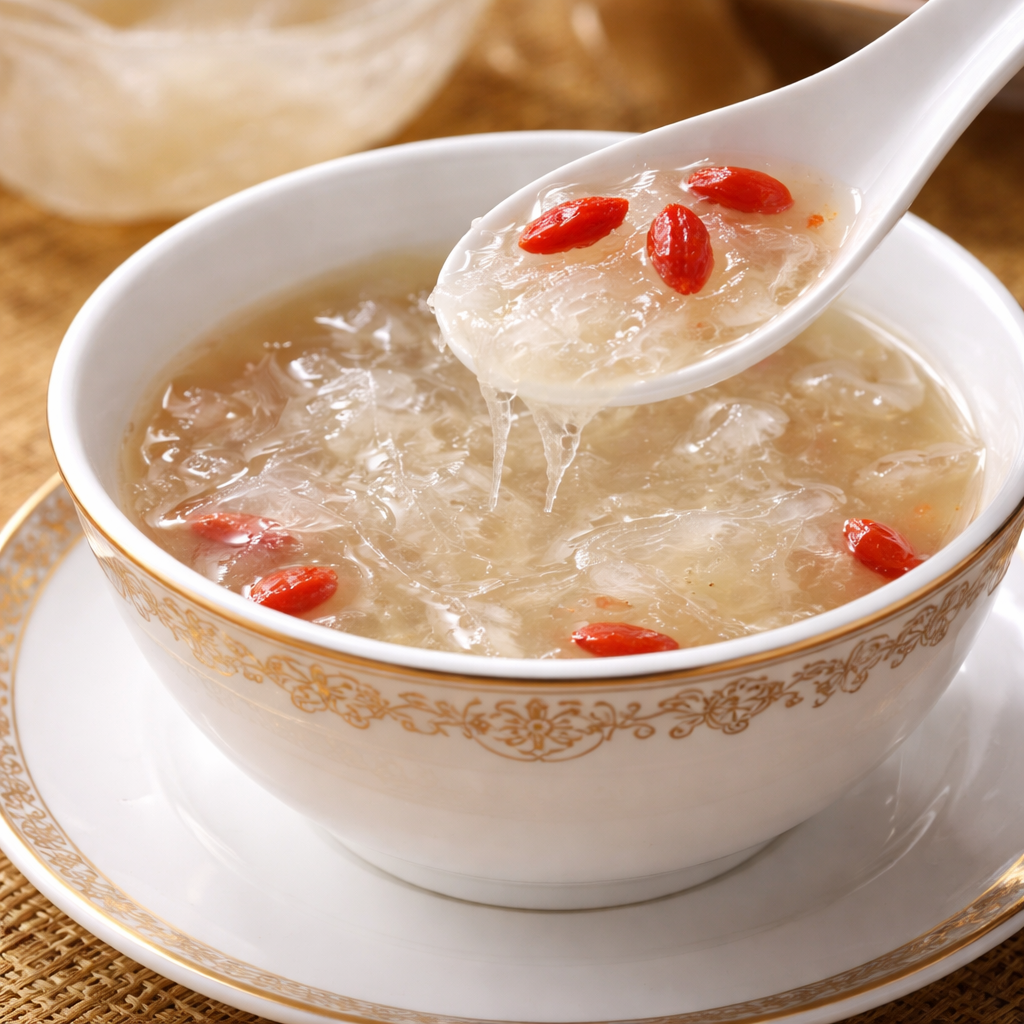
Few foods sit at the intersection of luxury, tradition, and modern skepticism quite like edible bird’s nest—the ingredient behind bird’s nest soup and the bottled “bird’s nest drinks” found across Asia and increasingly worldwide. Revered for centuries, it’s also one of the most counterfeited specialty foods on the market, and one whose “health claims” range from promising to overstated depending on what you expect science to prove.
Below is a thorough, practical, multi-section guide to what it is, where it comes from, how it’s consumed, what benefits have real evidence, what risks exist, and how to buy the good stuff while avoiding fakes.
Edible bird’s nest (EBN) is not a culinary nickname—it’s literal: a nest built primarily from solidified saliva of certain swiftlets (not swallows). The species most associated with edible nests include the edible-nest swiftlet (Aerodramus fuciphagus) and other swiftlets used in trade.
Historically, nests were harvested from limestone caves across parts of Southeast Asia (notably on islands and coastal cave systems). Over time—especially since the late 1990s—large portions of supply have shifted to purpose-built “swiftlet houses” designed to attract nesting birds.
Where it comes from (geographically):
Edible bird’s nest is strongly associated with Southeast Asia and Chinese cuisine, with major production and trade ties to countries such as Indonesia, Malaysia, Thailand, Vietnam, and strong consumption demand in China/, Hong Kong, Taiwan, and Singapore.
Bird’s nest soup is widely tied to centuries of Chinese culinary history, commonly dated to at least the Ming Dynasty, and described as a prized tonic served among elites.
Over time it became known (sometimes dramatically) as a “Caviar of the East” type of luxury ingredient: rare, labor-intensive to harvest, and socially symbolic—often served at banquets, weddings, important family celebrations, and business hospitality.
Traditionally, EBN is prepared as a delicate soup (often “sweet” in many modern preparations, or savory in some classic banquet-style versions). The nest strands soften into a gelatinous, lightly slippery texture.
Today, many consumers encounter EBN as a ready-to-drink bottled beverage (“bird’s nest drink”), typically sweetened and sometimes combined with rock sugar, flavors, or thickening stabilizers. These drinks may contain anything from visible nest strands to very small amounts of extract—so label reading matters (more on that in the quality section).
It can absolutely be eaten. In soup form, it’s eaten with a spoon; in bottled beverages it’s drunk, sometimes with chewable strands. The distinction isn’t “edible vs. drinkable”—it’s how much nest is present and how it’s processed.
Edible bird’s nest is often described in scientific reviews as containing proteins/glycoproteins, amino acids, and notable amounts of sialic acid, along with other compounds that may have bioactive properties.
This biochemical profile is one reason it’s been studied for potential effects relating to antioxidant activity, immune modulation, skin-related outcomes, and more—but it’s crucial to separate:
-
Traditional claims
-
Animal/in-vitro research
-
Human clinical evidence (which is still relatively limited)
Let’s be precise with language here. There is scientific research on EBN’s bioactive properties, but much of the strongest mechanistic evidence is in vitro (lab) or animal research, with fewer high-quality, large human trials.
Multiple studies and reviews discuss antioxidant-related activity and downstream implications for aging-related processes. That’s not the same as “proven anti-aging in people,” but it supports why researchers keep investigating it.
A 2021 study examined whether daily intake of EBN extract reduced UV-induced skin damage in mice. That’s meaningful as a research direction, but it remains animal evidence, not a guaranteed human cosmetic outcome.
You’ll see research exploring EBN in areas like cognition, reproductive function, and digestive health, often as mechanistic or early evidence rather than settled clinical guidance. Examples include more recent research discussions in peer-reviewed venues.
Bottom line on “proven benefits”:
-
It’s fair to say EBN has bioactive components and documented biological activity in lab/animal models.
-
It is not fair to claim it is a clinically proven cure-all, or that all traditional claims are confirmed by rigorous human trials.
Because EBN is an animal-derived product harvested and processed across varied settings, the risk conversation matters.
• Allergic reactions (including severe)Edible bird’s nest has been documented as a cause of IgE-mediated allergic reactions, including anaphylaxis in some reports. If someone has a history of serious food allergies or asthma/allergic disease, extra caution is warranted.
• Contamination risks (nitrite, heavy metals, microbes, mites)Peer-reviewed reviews and studies note possible residual contaminants including nitrite, heavy metals, fungi/bacteria, and even mites, depending on environment and handling/processing. Hong Kong’s food safety authority has specifically discussed nitrite in bird’s nest and why it may occur (environmental contamination/fermentation conditions are among proposed explanations).
Because the product is expensive, it’s vulnerable to:
-
Bleaching/whitening
-
Artificial coloring
-
Added materials to increase weight/shape (gums, gelatin-like substances, seaweed/agar, etc.)
Analytical literature and industry testing notes discuss the reality of adulteration and methods used to detect it (spectroscopy-based screening is one example).
Quality is typically evaluated by:
-
Cleanliness (how much feather/impurity remains)
-
Shape and integrity (whole “cup” nests vs broken pieces)
-
Color (natural white/off-white; sometimes yellowish; “red/blood nest” is complicated and frequently misunderstood)
-
Aroma (should not smell strongly chemical)
Note: popular writing often repeats the myth that “blood nest” is literally from blood; many sources emphasize that the red coloration is not simply “blood in saliva,” and the category is also a target for misrepresentation.
Step 2: Prefer traceability and documented testingFor higher confidence, look for:
-
Batch/lot identification
-
Country of origin + exporter/manufacturer details
-
Food safety testing (microbial counts, nitrite/nitrate, heavy metals)
-
Compliance with recognized import standards/SOPs (especially where export to China requires formal procedures and oversight)
If a seller cannot provide any meaningful traceability, that’s a red flag in a category known for fraud.
These aren’t foolproof, but they’re common sense screens:
-
Fiber structure: Real nests look striated and fibrous, not uniformly smooth or gelatin-sheet-like.
-
Soaking behavior: Authentic nests typically expand and soften while retaining recognizable strands; many fakes dissolve quickly into mush or break into uniform granules.
-
Water clarity: Some sellers note that soaking water from authentic nests tends to remain clearer, while dyed/colored fakes may leach color. (Helpful clue—just not a laboratory test.)
Counterfeits may be made from agar/seaweed gels and other thickeners designed to mimic the “strand” look.
Others may be “real nest” that’s been padded with additives to increase weight and improve shape—exactly the kind of issue analytical screening methods target.
If you remember nothing else, remember this list:
-
Unnaturally bright white nests (possible bleaching)
-
No origin, no batch info, no testing claims (or vague “lab tested” with no details)
-
Prices that are too good to be true (this is a high-cost commodity; extreme bargains often have a reason)
-
Strong chemical smell (not normal)
-
Bottled drinks with “bird’s nest” branding but tiny nest content (not necessarily “fake,” but possibly a marketing illusion—check the percentage/grams if listed)
Bird’s nest soup and bird’s nest drinks are best understood as:
-
A historic luxury food with deep cultural roots and centuries of culinary prestige
-
A biologically interesting ingredient (especially glycoproteins and sialic acid-related research), with a growing body of scientific study
-
Not a miracle medicine, and not “proven” for many of the sweeping health promises seen in marketing
-
A product category where safety and authenticity depend heavily on sourcing and testing, because contamination and adulteration are well-documented concerns