






Luang Prabang - Pak Ou Caves
royal history and the sacred mystery of the pak ou caves
12/15/2025
Luang Prabang feels like a place that learned how to hold time gently. Set on a finger of land where the Mekong River and the Nam Khan meet, the former royal capital of Laos carries its history not only in chronicles, but in rooftops, river fog, temple bells, market chatter, and the slow, deliberate rhythm of daily ritual. Its identity is famously layered—traditional Lao urban form and architecture braided with European colonial-era buildings—so intact that UNESCO recognized the “Town of Luang Prabang” for precisely this rare, well-preserved fusion.
But Luang Prabang is more than photogenic heritage. It is also a working town: a center of craft—especially silverwork—surrounded by culturally distinct highland communities, and anchored spiritually by sites that have drawn pilgrims for centuries. Among these, the Pak Ou Caves stand apart: a cliffside sanctuary filled with thousands of Buddha images, facing the Mekong like a quiet vow. What follows is a deep, multi-layered look at Luang Prabang’s story—its royal past, its silver industry, the hill tribes of the surrounding mountains, and the enduring magnetism of Pak Ou.
Long before Luang Prabang became a UNESCO world heritage name spoken by travelers, it was Muang Swa—an early settlement whose fortunes rose with the consolidation of Lao kingdoms. By the mid-14th century, the city became central to the Kingdom of Lan Xang (“Land of a Million Elephants”), a major power in mainland Southeast Asia. Historical references commonly point to 1353 as the beginning of Lan Xang’s consolidation, with the royal center associated with Muang Swa/Luang Prabang in that era.
One of the most symbolic threads in this royal story is the Phra Bang—a revered Buddha image associated with sovereignty and legitimacy. The name “Luang Prabang” itself is tied to this image, commonly interpreted as honoring the “Royal Buddha Image,” and marking the city as a place where political authority and religious sanctity reinforced one another.
Power, however, rarely stays still. Sources describe the royal court’s movement away from Luang Prabang in the 16th century, reflecting political and strategic shifts within Lan Xang. Then came the fragmentation: with the partition of Lan Xang in the early 18th century, Luang Prabang emerged as the capital of a distinct kingdom—again royal, again symbolic—yet now in a landscape of competing centers. This repeated “return” to royal status matters. It helps explain why Luang Prabang’s cultural atmosphere feels so courtly even today: the density of temples, the ceremonial architecture, and the way religious life is woven into the town’s public face are not accidental—they are the long echo of capital-city identity.
In the late 19th and early 20th centuries, French colonial administration left a visible imprint across Laos, and Luang Prabang became one of the clearest places to see what happens when two urban traditions settle into one another rather than erasing each other.
UNESCO’s description of Luang Prabang emphasizes exactly this: traditional Lao structures and urban form blended with European colonial buildings, producing a townscape that illustrates a key stage in cultural and architectural fusion.
Walk the old quarter and you can read this fusion in real time:
-
Lao temple compounds and monastery walls, dense with ornament and cosmological meaning
-
French-era villas and civic buildings with shutters, balconies, and measured proportions
-
A street logic that feels intimate rather than grand—more “town” than “capital”—even while the spiritual and royal weight is unmistakable
This is part of why Luang Prabang doesn’t feel like a museum: the town still behaves like a living settlement, not a frozen display. The built environment supports daily ritual—monks collecting alms at dawn, markets setting up before the sun, festivals that fill streets rather than occupying fenced-off “heritage zones.” (Many modern descriptions of Luang Prabang also highlight the persistence of these rituals across the protected area.).
Across Laos, textiles, wood, bamboo, paper, and metalwork form a constellation of traditional arts. In Luang Prabang, silverwork stands out because it sits at the crossroads of:
-
religious tradition (temple objects and offerings),
-
social status (jewelry, ceremonial pieces),
-
and modern cultural economy (workshops, boutiques, and artisan markets).
The province’s tourism and cultural institutions explicitly present silversmithing as a “things to do” heritage craft, with named local shops and villages tied to the tradition.
Luang Prabang’s silver scene is not one monolithic “industry”—it’s an ecosystem. At one end are family workshops producing fine hand-chiseled pieces; at the other are visitor-facing studios where travelers can observe or even participate in the making process (a newer layer that can help sustain income, but also changes what gets made and why).
Local and travel industry sources regularly point visitors toward silversmith shops and artisan experiences, reflecting how craft has become part of Luang Prabang’s cultural economy.
While styles vary by maker, you’ll often see:
-
bracelets, rings, earrings, and pendants with Buddhist or nature motifs
-
repoussé and chasing techniques (raised relief and detailed line work)
-
references to naga (serpents), lotus forms, protective symbols, and temple-inspired patterns
-
occasional incorporation of local stones or mixed metals, depending on the artisan
Importantly, in a heritage town, craft is not merely “souvenir production.” It is one of the ways heritage remains economically alive. When done well—fairly paid, transparently sourced, respectful of cultural meaning—silverwork becomes a form of preservation that feeds families, trains young artisans, and keeps skills from slipping into history books.
Northern Laos is ethnically diverse, and Luang Prabang sits near mountain areas where many minority communities live. Commonly referenced groups in the region include the Khmu and Hmong, among others—each with distinct languages, histories, clothing traditions, and agricultural practices. For visitors, “hill tribe” is often encountered through trekking routes or village visits; for residents, these communities are neighbors, trading partners, and—at times—migrants to town.
Hill communities have long contributed to the wider regional economy through:
-
upland agriculture (including shifting cultivation in some areas),
-
forest products,
-
textile and craft traditions,
-
and labor flows into towns.
Modern tourism has added a new dimension: guided treks that introduce travelers to Hmong and Khmu villages around Luang Prabang.
Luang Prabang’s charm is not only in its temples—it’s in its human landscape, too, and that landscape extends into the hills.
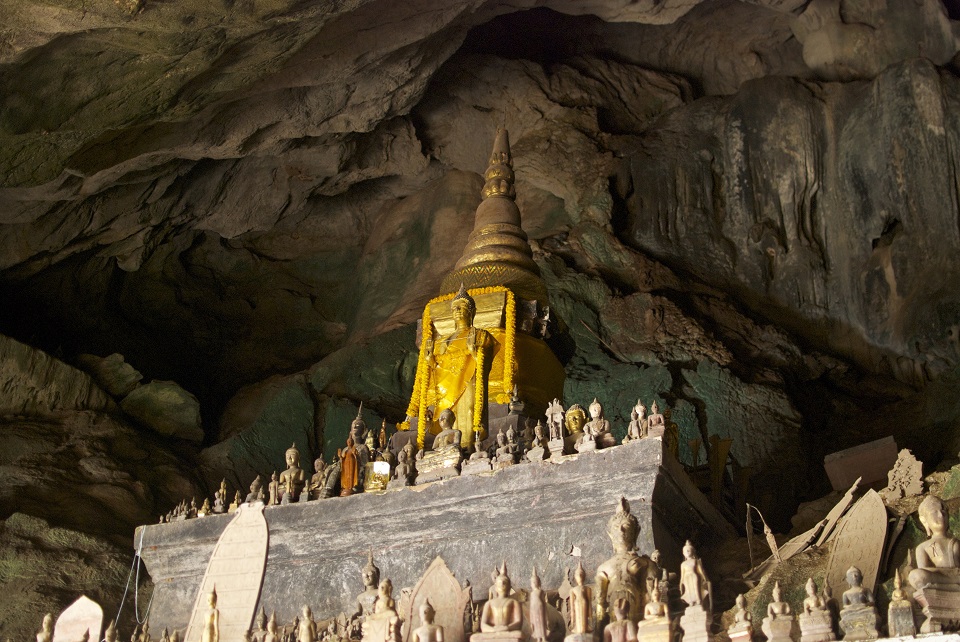
If Luang Prabang is a city where faith is public, Pak Ou is where faith becomes intimate. The Pak Ou Caves sit on a limestone cliff above the Mekong, roughly 25 km from Luang Prabang (often reached by boat), near the mouth of the Ou River—hence the name “Pak Ou.” Approaching by water is not a tourist gimmick—it is part of the meaning. The Mekong is a spiritual and economic artery. To travel upstream toward a sanctuary is to experience the landscape the way generations of pilgrims did: carried by current, surrounded by jungle ridges and river villages, arriving at a sacred place that reveals itself slowly.
Pak Ou is not a single chamber but a pair of caves:
-
Tham Ting (the lower cave), nearer the river and more naturally lit
-
Tham Theung (the upper cave), reached by climbing stairs and entering deeper darkness
That physical progression—light to dark, easy to demanding—mirrors a spiritual metaphor found across many traditions: the deeper the sanctuary, the quieter the self.
Pak Ou is famous for the astonishing quantity of Buddha figures—thousands—placed there over long periods. Sources vary on the estimate (commonly several thousand), and many note that the images include different sizes and styles, with some traditions dating portions of the collection back centuries.
The effect is unlike a curated museum display. The Buddhas feel accumulated—like layered prayers. Many are worn, darkened, chipped, or incomplete; that imperfection is part of their truth. They weren’t made to be “kept pristine.” They were made to be offered, carried, placed, and left—devotion made tangible.
Local descriptions often frame Pak Ou as one of the province’s most treasured religious symbols, tied to legends and long-standing practice of depositing Buddha statues over time.
This practice expresses something deeply Lao and broadly Buddhist: merit-making through offerings, the transformation of personal faith into communal sacred space, and the belief that a place can become powerful through repeated acts of reverence.
The caves as living heritageBecause Pak Ou is both sacred site and major visitor destination, it sits at a delicate intersection:
-
religious practice (still meaningful to locals)
-
heritage stewardship (conservation, management, respect)
-
tourism pressure (foot traffic, lighting, handling, commercialization)
The challenge—shared by many sacred heritage sites worldwide—is maintaining the caves as a place of devotion, not simply a place of viewing.
It can be tempting to treat “history,” “silver,” “hill tribes,” and “Pak Ou” as separate chapters. In Luang Prabang, they are one story.
-
The royal identity made Luang Prabang a spiritual capital as much as a political one.
-
The colonial layer preserved (and reshaped) the city’s physical form, creating the distinctive fusion UNESCO later recognized.
-
The silver industry continues the idea that beauty and devotion belong in everyday life—and turns heritage into livelihoods.
-
The highland communities remind us that Luang Prabang’s “culture” is regional, not confined within the old town’s streets.
-
And the Pak Ou Caves embody the river’s role as a sacred corridor—linking people, villages, and faith through movement and offering.
Luang Prabang endures because it is balanced: between kingdoms and villages, ritual and commerce, town and forested hills, sunlight on temple roofs and darkness in a cave filled with quiet gold.
Since 198, First Cabin Travel has offered custom luxury-styled itineraries to unique and varied destinations with the majority of bookings derived from repeat clientele and their enthusiastic referrals - much so that First Cabin has come to be know as Your Passport To Excellence. CA Reg: 2016168-40
