






Terra-Cotta Soldiers of China
The army that waited 2,000 years
8/20/2026
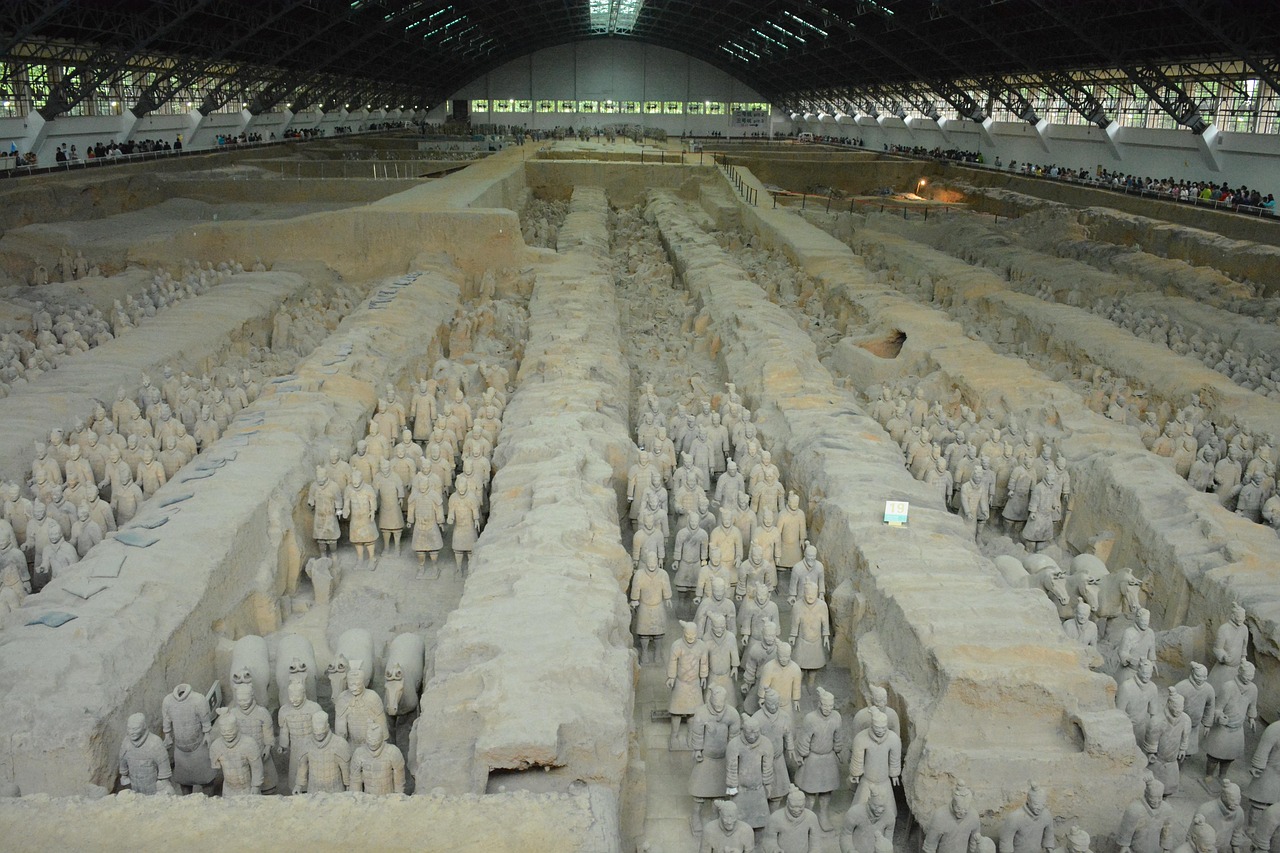
There are places in the world where history is displayed behind glass, carefully labeled and neatly separated from the present. And then there are places where history seems to rise directly from the earth.
Outside Xi’an, in China’s Shaanxi Province, thousands of clay soldiers stand in silent formation beneath vast protective halls. Infantrymen, archers, officers, generals and horses face east as though awaiting an enemy that will never arrive. Their weapons have largely disappeared, their once-brilliant colors have faded, and many of the figures bear the scars of more than two thousand years underground. Yet the impression remains astonishingly powerful.
This is the Terracotta Army, created for Qin Shi Huang, the ruler who became China’s first emperor and who transformed a collection of competing kingdoms into a unified imperial state. The warriors were not created as public monuments. They were never intended to be admired by visitors, celebrated as works of art or studied by archaeologists. They were created for eternity.
The enormous burial complex surrounding Qin Shi Huang’s tomb was conceived as an underground continuation of his empire, a world in which the emperor might retain the power, protection and authority he possessed in life. Construction began in 246 BC, when the future emperor was still a young ruler, and continued for decades. UNESCO describes a vast archaeological landscape covering more than 56 square kilometers, with nearly 200 associated pits and hundreds of archaeological sites.
For more than two millennia, much of it remained hidden. Then, in 1974, farmers digging a well encountered fragments of pottery. What emerged from the soil would become one of the greatest archaeological discoveries of modern times.
The Man Who Created an Empire
To understand the Terracotta Warriors, one must first understand the extraordinary ambition of the man for whom they were made. Qin Shi Huang was born in 259 BC and became king of the state of Qin while still a boy. China at the time was not the single political entity we recognize today. Powerful states competed for territory and supremacy during centuries of warfare. Qin ultimately prevailed.
In 221 BC, after defeating the remaining rival states, the king of Qin proclaimed himself Qin Shi Huang — the First Emperor of Qin. His title itself was a declaration that something new had begun. His reign was brief, but its consequences were enormous.
The First Emperor imposed greater political centralization and helped standardize systems of writing, currency, weights and measures. Roads and administrative networks helped bind previously separate territories together. The political structure established under Qin would influence Chinese government long after the dynasty itself disappeared.
He was also an authoritarian ruler whose government demanded immense labor and obedience. The same centralized power that allowed Qin Shi Huang to reshape a civilization also allowed him to undertake projects on a scale almost unimaginable for the ancient world. Among them was his own tomb.
An Emperor Thinking Beyond Death
Qin Shi Huang's mausoleum cannot properly be understood as simply a grave. It was an empire beneath the earth. Ancient accounts describe an extraordinary subterranean realm intended to reproduce elements of the emperor’s earthly world. The historian Sima Qian, writing approximately a century after Qin’s death, described a burial chamber containing palaces and treasures, representations of the heavens and the landscape, and rivers fashioned with mercury.
Modern archaeology has confirmed the extraordinary scale of the complex, although the emperor’s central burial chamber itself remains unopened. Around it, archaeologists have discovered evidence of a carefully planned ceremonial and administrative world: warriors and horses, bronze chariots, officials, entertainers and other figures, along with weapons, armor and architectural remains.
The concept is breathtaking. Death was apparently not intended to terminate the emperor’s reign. Instead, an alternative kingdom was prepared for him. The Terracotta Army was one component of that vision. Qin Shi Huang had conquered his enemies in life. In death, he would apparently continue to command an army.
Creating an Army From Earth
Nothing fully prepares a first-time visitor for the scale of Pit 1. Rows of life-size warriors extend into the distance beneath a monumental exhibition structure. The arrangement resembles a military formation rather than an art collection because that is essentially what it was intended to be. The army contains infantrymen, archers, cavalry, officers and generals, accompanied by horses and originally equipped with real weapons. The figures vary in clothing, hairstyle, headgear, armor, posture and facial characteristics.
That individuality is one of their greatest fascinations. From a distance they appear to be an army. Approach them more closely and they become men. One has a broad face and heavy mustache. Another appears younger. Some seem stern, others composed. Officers can be distinguished from ordinary soldiers through clothing and headgear, while generals carry the visual authority of rank.
Although the figures were produced through organized workshop methods using molds and standardized components, individual details were added and modified, producing an extraordinary variety of appearances. The result is a remarkable combination of mass production and individual craftsmanship.
The Metropolitan Museum of Art notes that scholars have studied these construction methods closely because they reveal the sophisticated organization behind their production. Even more remarkable is how different the warriors would have appeared when they were new.
Today we associate the Terracotta Army with the muted colors of fired clay. But the soldiers were originally painted. Their clothing, armor and details were covered in vivid pigments. Time underground, followed by exposure to air after excavation, caused much of that color to deteriorate rapidly. Modern archaeological teams therefore proceed with considerably greater caution than those working during the earliest excavations.
The monochromatic army familiar to the modern traveler is, in a sense, only the skeleton of the visual spectacle Qin Shi Huang commissioned. Imagine thousands of these figures fully painted, armed and standing in formation beneath the earth. It must have been extraordinary.
An Empire of Craftsmen
The creation of the mausoleum demanded resources on an almost unimaginable scale. Historical tradition states that hundreds of thousands of workers were involved in its construction. Craftsmen, laborers, engineers, potters, metalworkers and artists would have been required to transform the emperor’s vision into reality.
Construction began decades before Qin Shi Huang became First Emperor and continued until his death in 210 BC. UNESCO notes that workers from throughout the empire labored on what was effectively a subterranean city. The Terracotta Warriors also reveal something important about the civilization that created them. This was not merely a society capable of producing beautiful sculpture. It was capable of organizing production on an enormous scale.
Clay had to be obtained and prepared. Bodies, heads, arms and other components had to be manufactured, assembled, finished, fired and painted. Weapons had to be produced. Horses and chariots had to be created. Underground corridors and timber-roofed pits had to be engineered. Thousands of individual objects had to become a single coordinated military formation. The project therefore offers a remarkable glimpse into Qin China’s craftsmanship, technology, military organization and administrative power.
The Emperor's Final Journey
Qin Shi Huang died in 210 BC while traveling through his empire. He was approximately 49 years old. The dynasty he founded would not enjoy the longevity suggested by his title of First Emperor. Rebellion followed his death, and the Qin Dynasty collapsed only a few years later. His mausoleum, however, endured. At some point in antiquity, parts of the complex were damaged, burned or looted. Wooden structures collapsed. Warriors were smashed and buried beneath fallen earth. The once-organized underground army disappeared from human view. Dynasties rose and fell. China changed beyond recognition. Xi’an became one of the great historic cities of Asia. And beneath nearby fields, the soldiers waited.
The Day the Earth Opened
In March 1974, farmers near Xi’an were digging a well when they encountered unusual fragments of fired clay. It was an accidental discovery with extraordinary consequences. Archaeologists were summoned, and investigation revealed that the fragments belonged to life-size figures. As excavation expanded, the magnitude of the site gradually became apparent. This was not an isolated statue. It was an army. The original discovery became known as Pit 1, the largest and most visually spectacular of the principal warrior pits. Additional pits were subsequently identified, revealing different military formations and command arrangements.
In 1975, Chinese authorities decided to establish a museum over the archaeological site, and the museum associated with Pit 1 opened to the public in 1979. Additional pits were later opened for visitors. In 1987, the Mausoleum of the First Qin Emperor was inscribed on the UNESCO World Heritage List, recognizing both its artistic importance and its extraordinary historical value. A secret created for one man had become the inheritance of the world.
The Warriors Today
For the modern traveler, the Terracotta Army is one of China's defining cultural experiences. The site lies outside Xi’an, the ancient city that once served as an imperial capital and later became famous as the eastern terminus of the Silk Road. Visitors today encounter not a conventional museum but an active archaeological landscape.
The Emperor Qinshihuang’s Mausoleum Site Museum encompasses both the Terracotta Warriors museum and the larger mausoleum park. The principal warrior pits are protected beneath enormous structures that allow visitors to look directly into the excavated formations while conservation and archaeological work continue.
Pit 1 provides the unforgettable first impression. It is enormous. From elevated viewing areas, visitors look across row after row of warriors separated by earthen partitions. Restored soldiers stand in formation toward the front, while other sections reveal the complexity of excavation and reconstruction. The experience is partly museum, partly archaeological site and partly theater. There is something inherently dramatic about standing above an army that was never meant to be seen.
Pit 1: The Army
Pit 1 is the largest of the principal pits and contains the main battle formation. The soldiers stand in long corridors, arranged with military precision. Infantry dominates the formation, accompanied by chariots and other military elements. Even surrounded by visitors, the scale creates moments of remarkable stillness. The eye begins by taking in the entire army but inevitably settles on individual soldiers. That is where the site becomes unexpectedly personal. A face fashioned more than two thousand years ago suddenly seems recognizable as a human face. The distance between ancient China and the modern visitor briefly contracts.
Pit 2: The Strategy
Pit 2 reveals a more complex mixture of military units. Here archaeologists found archers, cavalry, chariots and infantry, offering scholars important evidence about Qin military organization and battlefield strategy. For the visitor willing to look beyond the sheer spectacle, the pits become an extraordinary military document. These figures were not simply lined up decoratively. Their positions mattered. Their equipment mattered. Their ranks mattered.
The army was designed according to a recognizable military system, preserving information about warfare in ancient China that might otherwise have disappeared. UNESCO has specifically emphasized the archaeological value of the warriors, weapons, uniforms, horses and equipment as evidence of military organization during the period.
Pit 3: Command
Smaller than the others, Pit 3 is generally interpreted as a command center. Its relatively limited number of figures does not diminish its importance. Instead, it provides another layer of evidence that the underground army was conceived structurally. There were troops. There were officers. There was command. Even in eternity, Qin Shi Huang's military machine was organized.
The Emperor Remains Beyond Reach
Perhaps the greatest mystery lies not among the warriors but beneath the large burial mound nearby. The central tomb of Qin Shi Huang has not been excavated. That restraint is one of the most fascinating aspects of the site. Ancient texts describe an extraordinary interior, including precious objects and representations of rivers and seas made with mercury. Modern scientific investigations have added intrigue to those accounts, but archaeology has deliberately avoided simply opening the chamber. The reason is conservation.
The Terracotta Warriors themselves provided a powerful warning. Excavated objects can begin deteriorating almost immediately when exposed to new environmental conditions. Pigments that survived underground for two millennia have sometimes changed or disappeared after exposure to air, humidity and light.
Until conservation technology can provide greater assurance that whatever lies within the emperor’s tomb can be protected, patience may be the wiser form of archaeology. For now, Qin Shi Huang remains where his subjects placed him more than 2,200 years ago. The unopened tomb adds something rare to a major tourist attraction: genuine mystery. We know it is there. We have ancient descriptions of what may lie inside. But no living person has seen it.
Archaeology in Full View
One of the most compelling aspects of visiting the Terracotta Warriors today is that the story is unfinished. Excavation and research continue. Figures emerge not as pristine statues but often as shattered collections of fragments. Archaeologists painstakingly identify pieces, join them together and reconstruct individual warriors. A visitor may therefore see both the grandeur of the completed formations and the painstaking process required to restore them.
This transforms the site from a monument to the past into a living center of archaeological investigation. The army is still revealing itself. More than half a century after the first discovery, researchers continue to investigate the enormous mausoleum landscape, and UNESCO notes that thousands of statues may still remain underground. What the world knows today may represent only part of what Qin Shi Huang created.
From Imperial Secret to Global Destination
The irony surrounding the Terracotta Army is profound. It was designed to be hidden forever. Today it attracts visitors from around the world. The warriors have become international symbols of China, appearing in books, documentaries and exhibitions while selected figures and artifacts have traveled to major museums overseas.
Yet nothing compares with seeing them where they were discovered. Context changes everything. A single Terracotta Warrior displayed in a museum is a masterpiece of ancient sculpture. Thousands of warriors standing together in the earth outside Xi’an become something else entirely. They become an emperor’s idea made visible.
The site also illustrates how cultural tourism can support preservation when carefully managed. Protective structures shelter the excavated pits. Museums provide historical context. Conservation laboratories work to stabilize newly discovered material. Archaeologists continue their research while visitors observe the results. Tourism and archaeology therefore occupy the same landscape. The challenge is maintaining the balance between access and preservation.
Xi’an and the Journey Into Imperial China
For travelers interested in Chinese history, Xi’an provides an exceptional setting for the Terracotta Army. Long before modern Beijing became China's political center, Xi’an — historically known as Chang’an during several important periods — stood among the greatest cities of the ancient world. It was associated with emperors, merchants, monks and diplomats and later became famous as a starting point for the trade networks collectively known as the Silk Road.
A journey to the Terracotta Warriors therefore works best not as an isolated excursion but as part of a broader exploration of Xi’an. The city’s walls, temples, archaeological sites, cuisine and multicultural history provide a rich counterpoint to the imperial severity of Qin Shi Huang’s mausoleum. The Terracotta Army tells the story of political unification and imperial ambition. Xi’an tells many of the stories that followed.
Experiencing the Site in Style
The modern luxury traveler does not need to approach the Terracotta Warriors as a hurried sightseeing stop. Indeed, the site rewards precisely the opposite.
A private guide with expertise in Chinese history or archaeology can transform the visit. Without explanation, the army is spectacular. With context, small details become meaningful: the difference between an officer and infantryman, the position of an archer’s hands, the remnants of ancient paint, the arrangement of military formations and the painstaking reconstruction of broken figures.
Time should also be allowed simply to observe. Walk slowly. Look beyond the first ranks. Study the faces. Consider the fact that the soldiers were buried when Rome was still a republic and more than two centuries before the height of the Roman Empire. Then consider that the people who created them expected almost no one to see them. Luxury travel at its best is not merely about accommodation or exclusivity. It is about access to experiences capable of altering our sense of place and time. The Terracotta Army provides exactly that.
Eight Thousand Faces and No Two Quite Alike
The popular image of the Terracotta Army is one of endless repetition. The reality is far more subtle. Variations in hairstyles, clothing, armor, physical appearance and facial details give the warriors remarkable individuality. The army does not feel populated by anonymous mannequins. It feels populated by people.
This quality has inspired continuing debate about the production process and the degree to which individual soldiers might have been inspired by actual people. What is certain is that Qin craftsmen achieved an extraordinary balance between standardized production and individual detail. That achievement may be the artistic heart of the entire site. An emperor wanted thousands of soldiers. His craftsmen gave him thousands of personalities.
Power Made Permanent
The Terracotta Army can be admired simply for its beauty and scale, but its deeper significance lies in what it tells us about power. Qin Shi Huang spent his life creating unity where there had been division. He standardized. He centralized. He conquered. He built. And ultimately he attempted to extend that same order into death.
His mausoleum became the final expression of his political imagination. The underground world reproduced hierarchy. Soldiers guarded him. Officials served him. Horses and chariots transported him. Entertainers could amuse him. Treasures surrounded him. The emperor who controlled an earthly state attempted to create another realm beneath the ground. It is difficult to think of a more extraordinary expression of absolute authority.
The Paradox of Qin Shi Huang
History has never regarded the First Emperor simply. He is remembered as a unifier and a tyrant, an innovator and an autocrat, a builder of institutions and a ruler whose demands imposed tremendous burdens upon his people. His dynasty collapsed almost immediately after his death. Yet the political idea of a unified China survived. So did his tomb.
Perhaps that is why the Terracotta Army remains so compelling. It resists simple interpretation. It is magnificent, but its magnificence was made possible by extraordinary concentrations of power and labor. It is artistic, but it was created for political and spiritual purposes. It celebrates military strength, yet its soldiers have never fought a battle. It was intended to remain hidden, yet it has become one of the most recognizable archaeological treasures on earth.
The Silent Army
Eventually every visitor reaches a moment when historical dates and archaeological explanations become secondary. You simply look. Before you are thousands of faces from another age. They belonged to an emperor’s dream of immortality, created by craftsmen whose names are largely forgotten and buried beneath farmland for more than twenty centuries. Qin Shi Huang sought permanence. In one respect, he achieved it.
His political dynasty lasted only a few years beyond his death, but the army created to accompany him has survived for more than two millennia. The soldiers have outlived kingdoms, wars, revolutions and generations beyond counting. They were fashioned from ordinary earth. They became immortal. And beneath the fields outside Xi’an, many more may still be waiting.
Since 1989 First Cabin Travel has offered unique and varied itineraries to destinations worldwide with the mainstay of bookings derived from repeat clientele and their enthusiastic referrals - First Cabin has come to be known as Your Passport to Excellence. CA Reg: 2018168-40