






University Club San Diego
a century above the city
8/9/2026
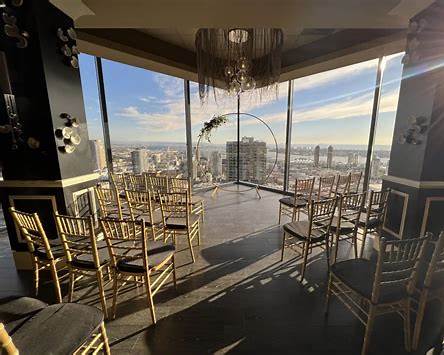
There are certain places that become inseparable from the identity of a city—not simply because of where they are located, but because of the people, conversations, celebrations and decisions that have taken place within their walls. In San Diego, few private institutions can claim that distinction quite like the University Club San Diego. Perched on the 34th floor of Symphony Towers in the heart of downtown, the University Club occupies one of the city’s most commanding settings. From this extraordinary vantage point, San Diego seems to unfold in every direction: the downtown skyline immediately below, the blue sweep of San Diego Bay beyond it, Coronado across the water, Balboa Park in the distance and the Pacific horizon stretching toward the west. Yet the views—spectacular as they are—tell only part of the story.
For more than a century, the University Club has been associated with the professional, civic and cultural life of San Diego. It has evolved from an organization founded around intellectual exchange into a contemporary private club where business, dining, networking, culture and social life come together. Its history reaches back to 1896, when eight men and thirteen women created the College Graduate Club as a place where educated San Diegans could exchange ideas and discuss important issues of the day. The University Club was formally organized in 1909, carrying forward an emphasis on literature, art, culture and intellectual engagement. More than a century later, that original spirit remains recognizable, although the Club itself has changed dramatically with San Diego.
To understand the University Club is to understand something about the evolution of San Diego itself. At the end of the nineteenth century, San Diego was still developing its identity as a major city. The College Graduate Club provided a gathering place for people interested in ideas, education and the important questions of their time. By 1909, the University Club had been formally incorporated as a private organization devoted to promoting literature, art and culture among its members.
The Club eventually established a clubhouse of its own, and as the decades passed its role expanded. What began largely as an academically inspired organization gradually became an important social and business institution. The transformation mirrored San Diego’s own growth. As the city developed into a center for business, defense, science, medicine, tourism, technology, higher education and the arts, the University Club increasingly became a place where people from those worlds could meet one another away from their offices and boardrooms. A major change came in 1989, when the Club relocated to Symphony Towers and became part of what is now the Invited network of private clubs. The move quite literally elevated the University Club.
Its home on the 34th floor placed members above the center of downtown San Diego, creating a setting that was simultaneously private and intimately connected to the city below. Today, University Club San Diego describes itself as a gathering place for professionals, creatives and civic leaders—a modern interpretation of the intellectual and community-minded organization established generations earlier.
It is impossible to discuss the University Club without discussing the view. There are impressive views throughout San Diego, but experiencing the city from the top of Symphony Towers provides an entirely different perspective. The elevation creates a panorama rather than a single vista.
From different areas of the Club, the landscape can include downtown San Diego, Balboa Park, San Diego Bay, Coronado and the Coronado Bridge, the Pacific Ocean and the surrounding mountains. The University of San Diego has described views from the Club that encompass such recognizable landmarks as the Hotel del Coronado, Petco Park, The Rady Shell and the San Diego Convention Center.
During daylight hours, the effect is expansive. The city spreads beneath the windows as aircraft approach and depart, ships move through the harbor and sunlight reflects from the bay. Toward evening, the experience changes. The western sky begins to soften, the Pacific horizon takes on the colors of sunset and lights gradually appear across downtown. Coronado and the waterfront become illuminated while the city below transitions from business day to evening. For a cocktail reception or private dinner, that transition can become part of the event itself.
Guests may arrive while San Diego is still bathed in afternoon light and find themselves, an hour later, looking across an illuminated city from hundreds of feet above the streets. The architecture and elevation do something else as well: they provide separation. Although the University Club is located directly in the heart of downtown, stepping into the Club creates the sensation of leaving the activity of the city behind. The streets, traffic and buildings remain visible, but from an entirely different perspective. That combination—being at the center of San Diego while seemingly removed from it—is one of the Club’s defining luxuries.
Private clubs historically served an important function that restaurants, offices and hotels could not always duplicate. They provided a familiar environment where relationships could develop over time. The University Club continues that tradition. A breakfast meeting may become a conversation between people from entirely different industries. Lunch can provide an opportunity to meet a client in an environment more distinctive than an office. An evening reception can introduce members who might otherwise never have crossed paths. That is one reason the Club has remained relevant even as the way people work has changed.
Modern business is increasingly digital. Meetings take place through screens, documents are exchanged electronically and professionals can work from virtually anywhere. Yet the importance of personal relationships has arguably become greater rather than smaller. The University Club offers the opposite of anonymous digital communication: a physical place built around conversation. Its membership brings together individuals from the professional, entrepreneurial, civic, creative and business communities. The result is an environment in which networking need not always resemble a formal networking event. Sometimes the most valuable introduction occurs at the bar, over lunch or while two members are simply admiring the same sunset.
DINING ABOVE SAN DIEGODining has long been part of the private-club tradition, but at the University Club the experience is enhanced by the surroundings. Rather than simply going out to dinner downtown, members can dine high above it. The Club includes the 1909 Founders’ Room, named for the year the University Club was formally established. The room has been described as Hollywood Regency in inspiration, with Frank Sinatra influencing its aesthetic—a fitting touch for a space intended to combine traditional private-club sophistication with a little glamour. Elsewhere, the Ebb & Flow Bar & Lounge provides a more relaxed contemporary social setting, reflecting the Club’s evolution away from the stereotype of the overly formal private club. That balance is important. The modern University Club can be appropriate for a serious business lunch in one moment and cocktails with friends in another. Members can entertain clients, celebrate personal milestones or simply stop in at the end of the day. In each case, the surroundings elevate what might otherwise be an ordinary occasion.
Part of the appeal of the University Club lies in the variety of its private spaces.
The Sefton Library, for example, has long been known among members as “The War Room.” Designed for intimate business gatherings, it accommodates approximately a dozen guests and includes rich wood details, upholstered walls and wine lockers. The room honors Thomas W. Sefton, the prominent San Diego banker, philanthropist and civic leader.
For executive gatherings, the 1896 Boardroom takes its name from the year the College Graduate Club was founded. Its purpose is decidedly contemporary: an executive meeting environment with audiovisual and videoconferencing capabilities.
The Crescendo and Encore rooms pay tribute to San Diego’s performing-arts community. The two spaces can function independently or be combined for larger dinners and receptions, an appropriate connection considering the Club’s location within Symphony Towers.
There is also a Wine Cellar designed for private tastings and dinners—an intimate alternative to the Club’s larger spaces. And then there is the Laureate Ballroom.
For weddings, galas, corporate celebrations and major receptions, the Laureate Ballroom represents one of the Club’s signature spaces.
Its principal decorative feature requires no designer at all: San Diego itself. The ballroom offers sweeping views that can extend from Balboa Park and the Pacific Ocean to Coronado and the bridge. Published venue information indicates capacity for approximately 180 seated guests or about 250 for a reception, making it substantial enough for an important celebration while retaining the atmosphere of a private club rather than a convention hall.
The University Club overall offers nine meeting rooms, with published venue information listing capacities as large as 500 for certain reception configurations. Customized menus and private-event facilities allow the Club to host everything from executive dinners and corporate gatherings to weddings and destination events. For an event planner, the setting offers an unusual advantage. There is relatively little need to explain to guests why the venue was chosen. The moment the elevator doors open and guests encounter the view, the location makes its own statement. A daytime luncheon possesses one personality. A sunset cocktail party has another. An evening gala, surrounded by the lights of downtown and the harbor, creates yet another experience entirely. The city effectively becomes the backdrop.
While its history may be formal, the contemporary University Club is not intended to function as a museum of private-club tradition. Its modern identity is considerably more social. The Club’s own history highlights events ranging from cultural celebrations and sunset gatherings to Halloween festivities and New Year’s Eve celebrations. Mexican Independence Day, “Sunset Sips,” grand-opening celebrations and other member gatherings illustrate how the Club has broadened its programming while maintaining its connection to business and civic life. That evolution is significant.
A generation ago, the image of a private metropolitan club might have suggested dark wood, formal lunches and a relatively narrow social circle. Today’s successful private clubs have had to become something more: part office, part restaurant, part social center, part event venue and part community.
The University Club has followed that path. A member might visit one day for breakfast, another day for a client meeting and return later in the week for cocktails or a special event. A couple may attend a dinner together. Business associates can meet privately. Members can introduce friends and colleagues to the Club.That versatility is perhaps the modern definition of luxury—not merely opulence, but access to a place that adapts to the different parts of one’s life.
ALocation is another important element of the University Club experience. Symphony Towers stands at 750 B Street, placing the Club squarely within downtown’s business and cultural district. The building itself is closely associated with San Diego’s performing-arts community, while hotels, theaters, offices, restaurants and many of the city’s major attractions are nearby. The Club describes its location as being just steps from downtown hotels, theaters and attractions. This creates an interesting convergence. The University Club is neither solely a business club nor solely a social club. It sits between the two. A member can move from an afternoon meeting to an evening performance or from a cultural event to cocktails at the Club without leaving the downtown core.
That proximity also makes it an appealing gathering place for organizations and institutions throughout San Diego. The Rotary Club of Downtown San Diego, for example, holds Wednesday morning meetings at the University Club, demonstrating the venue’s continuing connection to the civic community.
Universities and professional organizations have likewise used the Club for receptions and gatherings. In 2025, for example, the University of San Diego School of Law held an alumni summer reception there, specifically emphasizing both its central downtown location and its remarkable skyline views.
Part of the enduring attraction of private clubs is precisely that they are private. In a city filled with restaurants, rooftop lounges, hotels and public gathering places, privacy has become a luxury of its own. A member knows that the University Club is not simply another crowded downtown venue. It is a place where the staff, surroundings and membership community are designed around repeat relationships. That distinction changes the atmosphere. A restaurant is somewhere one visits. A private club, at its best, becomes somewhere one belongs. Over time, members recognize familiar faces. Introductions lead to friendships. Professional relationships cross into social circles. A bartender remembers a preference. A favorite table becomes familiar. Annual celebrations become traditions. This is the less tangible side of club membership and perhaps the hardest to reproduce elsewhere.
Longevity can be both an advantage and a challenge for an institution. A club founded more than a century ago must respect its history without becoming trapped by it. The University Club has repeatedly reinvented itself. Its timeline includes the establishment of the College Graduate Club in 1896, the formal organization of the University Club in 1909, establishment of its own clubhouse in 1916, major redevelopment in 1970 and the transformative move to Symphony Towers in 1989. Each stage represented an adaptation to a changing San Diego. The Club of today is therefore not simply the preservation of an old institution. It is the latest chapter in an institution that has repeatedly changed along with the city surrounding it. Its contemporary interiors and social spaces speak to a new generation, while room names such as the 1896 Boardroom and 1909 Founders’ Room quietly preserve the historical thread. That combination gives the University Club something difficult for a newly created venue to manufacture: heritage.
There is also undeniable prestige associated with entertaining at the University Club. Inviting a client to lunch there is different from suggesting an ordinary downtown restaurant. Holding a reception on the 34th floor of Symphony Towers immediately gives an occasion a sense of importance. The effect does not necessarily come from formality. It comes from context. Guests enter one of downtown San Diego’s landmark towers, ascend to the uppermost levels and emerge into a private environment overlooking the city. That sequence creates anticipation.
For weddings and milestone celebrations, it adds drama. For corporate events, it communicates confidence. For nonprofit gatherings, it can elevate the perceived importance of the occasion. For intimate dinners, it creates a sense that guests have been invited somewhere special. And for members entertaining visitors from outside San Diego, there may be few more efficient ways to introduce the city. From one extraordinary vantage point, a guest can begin to understand San Diego’s geography: downtown beneath them, Balboa Park beyond, the harbor and Coronado across the water and the Pacific stretching toward the horizon.
Perhaps the University Club is most dramatic during the hour when day becomes evening. Late-afternoon sunlight moves across the skyline. Buildings take on a warmer tone. The water changes color. The western horizon begins its nightly performance. Then, gradually, the city illuminates. From 34 floors above downtown, the transformation is striking. Headlights begin tracing the streets below. Office towers glow. Petco Park and the Convention Center become part of the nighttime landscape. Across the bay, Coronado sparkles against the darkening water. It is a reminder that the University Club’s greatest design feature is not contained within its walls. It is outside the windows. San Diego is the artwork.
It would be easy to describe the University Club primarily in terms of its spectacular location. That would also miss the point. Buildings do not survive as institutions for more than a century because they have beautiful windows. They survive because people continue to find reasons to gather inside them.
That is the real story of the University Club San Diego. Beginning with 21 San Diegans who gathered in 1896 to discuss the issues and ideas of their time, the organization has always been about bringing people together. The surroundings have changed enormously. The small San Diego of the late nineteenth century has become one of America’s great metropolitan regions. The original gatherings eventually gave way to a permanent clubhouse, which in turn gave way to a modern facility and ultimately to the Club’s spectacular home atop Symphony Towers.
Yet the fundamental idea has remained surprisingly consistent.
• People come together.
• They exchange ideas.
• They conduct business.
• They celebrate.
• They dine.
• They make introductions.
• They build friendships.
And occasionally, perhaps in the middle of a conversation, they stop and look out the window. Thirty-four floors below them is the San Diego of today—a city dramatically different from the one in which the Club’s founders first gathered in 1896. From one of the most privileged vantage points in Southern California, the University Club continues to look out over that changing city while remaining very much a part of it. More than a private club, it is a meeting place between San Diego’s history and its future—and one of the few places where the city itself is always the guest of honor.