






Yurts - In Mongolia
The yurts of Mongolia—gers—originated thousands of years ago
12/10/2025
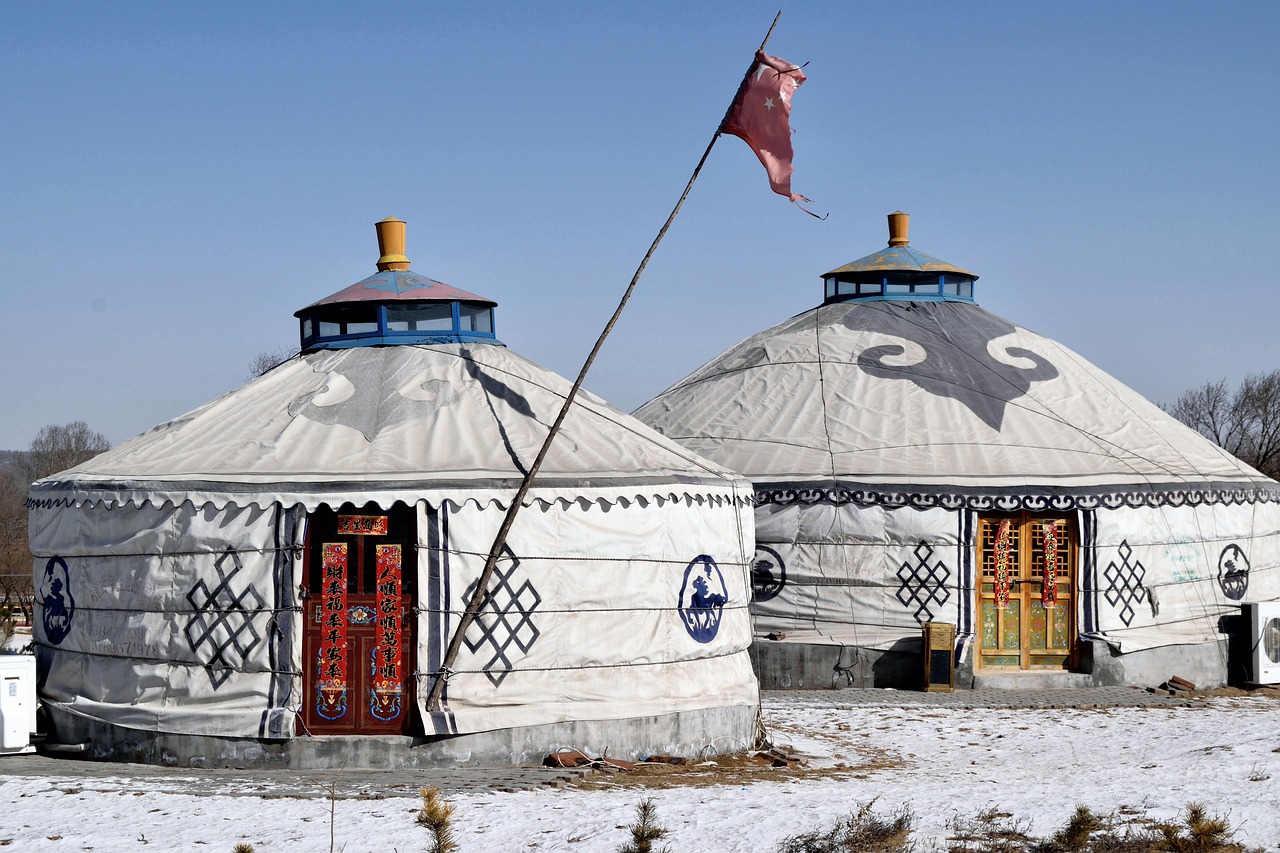
Yurts—known in Mongolia as gers—are among the world’s most remarkable human habitats: portable, circular homes that have sheltered nomadic herders across the Central Asian steppe for thousands of years. In Mongolia, the ger is far more than “a tent.” It is a finely engineered, symbolic, and deeply loved home that has shaped the country’s history, social life, and even its cityscapes.
In English we often say yurt, but Mongolians themselves most commonly say ger, which simply means “home.” A yurt/ger is a portable, round, felt-covered dwelling made with a wooden lattice wall, radiating roof poles, and a central roof ring. Traditionally it is:
-
Circular for stability against fierce steppe winds
-
Low and domed, shedding wind and conserving heat
-
Insulated with thick layers of felt (usually sheep’s wool)
-
Designed to be dismantled, transported, and rebuilt many times a year
A typical family ger can be erected or taken down in about an hour or two by a few adults working together, yet it can withstand temperatures from blistering summer heat to winter cold that plunges well below –30°C (–22°F).
The roots of yurt-like dwellings go back at least 2,500–3,000 years in Central Asia:
-
The Greek historian Herodotus (5th century BCE) described felt-covered, wagon-borne tents used by Scythian nomads, often considered ancestors of later steppe peoples.
-
A bronze bowl from the Zagros Mountains (around 600 BCE) shows round, tent-like structures interpreted as early yurts.
-
Modern scholarship and popular histories generally agree that trellis-walled yurts emerged as a distinctive dwelling form at least three millennia ago among nomads of the Eurasian steppe.
As nomadic cultures evolved, so did their homes:
-
Early Central Asian nomads perfected portable felt tents suited for horse-based herding.
-
In Mongolia, the ger became the primary dwelling for Mongol tribes and clans, including those who later coalesced under Chinggis (Genghis) Khan in the 13th century.
-
Royal or imperial tents could be enormous, sometimes placed on wheeled platforms pulled by oxen or yaks—effectively moving palaces.
By the time of the Mongol Empire, the ger was not only a home but a symbol of mobile power, traveling with armies and courts across Eurasia.
The Mongolian ger is beautifully simple in appearance yet carefully engineered. It consists of two main systems: the wooden framework and the felt (and fabric) coverings.
-
Khana (Хана) – the lattice wall
-
Folding wooden lattice sections that expand into a circular wall.
-
Typically made from tough, flexible woods such as larch or other local timbers.
-
Tied together with rawhide or modern cord, giving both flexibility and resilience.
-
-
Toono (Тоono) – the crown or roof ring
-
A circular wooden ring at the top that acts as a compression hub.
-
It has holes/notches around its perimeter where the roof poles fit.
-
The central opening functions as smoke hole, skylight, and symbolic “eye of heaven.”
-
-
Uni (Үни) – the roof poles
-
Slender poles that run from the top of the khana up into the toono, forming a kind of wooden umbrella.
-
In self-supporting gers, the tension of these poles and a tension band around the top of the wall hold the entire structure in equilibrium.
-
-
Bagana (Багана) – central pillars
-
Many Mongolian gers have two vertical pillars supporting the toono from below.
-
These are often ornately carved and painted; symbolically they can represent strength, stability, and sometimes masculine energy or the axis of the world.
-
-
Door frame and door
-
Traditionally a felt flap; today often a solid wooden, brightly painted door facing south (for light and protection from north winds).
-
The outer layers are equally important:
-
Felt: Thick, durable felt is made from sheep’s wool, cleaned, carded, wetted, and rolled or beaten until fibers mat together. Several large felt panels cover the walls and roof.
-
Canvas or outer cover: In modern gers, an additional cotton or canvas layer protects the felt from rain and wind.
-
Ropes and bands: Long hair ropes (traditionally horsehair or camelhair) and modern nylon bands wrap around the ger, cinching it together and resisting gusts.
Crafting a ger is a specialized trade. Skilled artisans:
-
Select and season wood, steam-bend parts of the toono, and carve decorative motifs often influenced by Buddhist and steppe patterns.
-
Hand-make felt covers, a laborious task that can take many days per set.
-
A new ger frame and felt set can last years or even decades if maintained, patched, and periodically re-roped.
Assembling an existing ger on site typically takes a family 30 minutes to a few hours, depending on size and experience.
Traditionally, each nuclear or extended family has its own ger:
-
A typical ger might house 5–10 people (parents, children, sometimes grandparents).
-
Yurts in a herding camp are usually spaced respectfully apart but within walking distance, often forming small clusters of related families or clans.
Historical accounts suggest that Mongolian nomads might move camp at least 3–4 times per year to follow grazing conditions, water, and seasons. In the past, large encampments of a powerful khan could contain dozens or even hundreds of gers, including vast royal tents that served as mobile palaces and administrative centers.
Social order inside the gerThe interior is carefully organized:
-
The door faces south.
-
The north side, opposite the door, is the place of honor, often with family altars, photos, or religious objects.
-
The western side (men’s side) traditionally stores saddles, tools, and men’s possessions.
-
The eastern side (women’s side) holds kitchen implements and household items.
This layout encodes centuries of gender roles, hospitality customs, and spiritual beliefs.
At the center of a ger stands its heart: the stove.
-
Traditionally, a metal or clay stove sits beneath the toono; its chimney runs up through the roof opening.
-
It is used for both heating and cooking, with a kettle or pot almost always on top for tea or stew.
The main fuels have historically been:
-
Dried animal dung (“argal”) – collected from sheep, goats, cows, yaks, and camels, then dried into clean, hard patties. This has been a primary fuel on treeless grasslands.
-
Wood, in forested or riverine regions.
-
More recently, coal, especially in peri-urban “ger districts” around Ulaanbaatar, though this has led to serious air-quality issues.
Despite modern concerns, dung remains a highly practical and sustainable fuel in remote areas: it is abundant, lightweight, and burns slowly, providing steady heat through bitter winters.
Modern improvementsBecause of concerns about pollution and efficiency, many initiatives are exploring:
-
Better-sealed, better-insulated gers heated by efficient stoves or electric systems, which can actually be cheaper to run than coal in some contexts.
-
Improved stoves in Ulaanbaatar’s ger districts to reduce emissions and indoor PM2.5 levels.
Still, the basic image of family gathered around the central stove, sipping salty milk tea (suutei tsai), remains iconic.
Very much so—they are not relics; they are living homes.
In Mongolia today recent estimates show that:-
Roughly 25–30% of Mongolia’s population still live a fully nomadic or semi-nomadic lifestyle, moving with herds and living in gers.
-
Around 38% of Mongolians—about 340,000 people—live in gers overall, including both countryside and city “ger districts.”
-
In Ulaanbaatar, the capital, around 60% of the population lives in ger districts that ring the city, many in self-built neighborhoods lacking full infrastructure. M
These figures make the ger one of the most widely used traditional dwellings on Earth today.
The yurt/ger form is also used by:
-
Kazakh, Kyrgyz, Turkmen, and other Central Asian peoples, often with regional variations in design and decoration.
-
Tourist camps in Mongolia and Central Asia, where visitors stay in gers to experience nomadic life. Go Mongolia Tours+1
-
Modern eco-resorts and “glamping” sites worldwide, which adapt the basic structure using hardwood platforms, glass domes, and modern insulation.
So while construction materials may modernize, the spirit and geometry of the ger remain strikingly constant.
The density of gers varies dramatically depending on setting:
-
Rural herding areas:
-
Families may be miles apart, separated by open steppe, sharing only seasonal wells and pasture lands.
-
A “neighborhood” in this context might be just a handful of gers within sight of each other.
-
-
Traditional camps:
-
Clan or family groups might gather in clusters of several to dozens of gers, especially during community events or pastoral tasks like shearing and branding.
-
-
Urban ger districts:
-
Around Ulaanbaatar and some provincial capitals, ger districts can contain tens of thousands of gers in dense, sprawling layouts—more like suburbs of round houses than isolated tents.
-
Thus, a visitor might see a single lonely ger against an endless skyline in the countryside, or entire hillsides of white-domed roofs in the capital.
In a typical Mongolian ger:
-
The central stove is always in use—tea boiling, stew simmering.
-
Beds or wooden platforms line the walls; wardrobes and chests store clothing and valuables.
-
Saddles, bridles, and tools hang ready for horseback work.
-
Rugs and carpets add warmth and color underfoot.
Hospitality is a core value: travelers are welcome to enter, share tea and food, and exchange news. Refusing guests would historically be unthinkable in such a sparse landscape.
Over centuries, Mongolian gers absorbed Buddhist and shamanic symbolism:
-
The toono is sometimes shaped or painted as a Dharmachakra (Wheel of the Law), aligning the house with Buddhist cosmology.
-
Colors and motifs on pillars, doorways, and furniture often reflect protective symbols, auspicious animals, and abstract knots of eternity.
-
The upward-opening smoke hole reinforces the idea of a vertical connection between earth, family, and sky.
Nomadic life depends on easy dismantling and transport:
-
A family can disassemble its ger, load the collapsible khana, the toono, the uni, felt covers, and furniture onto a few animals or a truck, and move to new pastures.
-
Historically, large gers, especially royal ones, might be carried whole on wheeled platforms pulled by up to 22 yaks or oxen.
The yurt’s genius lies exactly here: it is a real house that behaves like luggage—sturdy, warm, and ritualized, yet fundamentally portable.
Yurts in Mongolia stand at a crossroads between tradition and modernization.
Challenges-
Climate and environment: Long, harsh winters plus coal-fired stoves in urban ger districts contribute to pollution, prompting efforts to transition to cleaner heating.
-
Urbanization: Many herders are moving to cities, and their gers become fixed homes in peri-urban settlements rather than mobile dwellings on open grassland.
Yet the ger endures because it is uniquely suited to both landscape and culture:
-
It remains the standard rural home for herding families.
-
Craft traditions—carving, painting, felting—are still being passed down and, in some cases, revived for cultural tourism.
-
Designers and environmentalists around the world are looking to the ger/yurt as a model of low-impact, climate-sensitive housing in a warming world.
In this sense, the Mongolian ger is both ancient and surprisingly contemporary: a dwelling that has seen empires rise and fall, yet still feels at home in the 21st century.
The yurts of Mongolia—gers—originated thousands of years ago among nomadic peoples of the Central Asian steppe. Crafted from a lattice of wood, roof poles, and a central crown, covered in thick felt and held together by ropes, they are:
-
Portable homes that can be erected in an hour yet last for years.
-
Ingenious climate shelters, heated by dung-fueled stoves and wrapped in wool.
-
Social and spiritual spaces, ordered by custom and filled with hospitality.
-
Very much alive today, sheltering hundreds of thousands of Mongolians from distant steppe pastures to crowded urban ger districts.